

Pineapple (Ananas comosus): A comprehensive review of nutritional values, volatile compounds, health benefits, and potential food products
fresh pineapple juice may help with parasites due to the bromelain enzyme, it’s not a definitive cure and should not be relied upon as a primary treatment. Bromelain can weaken or even destroy parasites by breaking down the proteins they rely on, but canned pineapple juice loses this effect due to the heat used in processing. For persistent or severe parasite infections, consult a doctor for appropriate medication, as natural remedies alone may not be sufficient, says a health article from Healthline.
Here’s a more detailed explanation:
-
Bromelain’s Role:Pineapple contains the enzyme bromelain, which is known for its ability to break down proteins. Intestinal worms rely on proteins for survival, so bromelain can weaken or even destroy them.
View this post on Instagram
Highlights
-
Pineapple is rich in nutrients, dietary fiber, and bioactive compounds.
-
The volatile compounds of pineapple arise from esters.
-
Pineapple offers various potential food-based and waste processing products.
Abstract
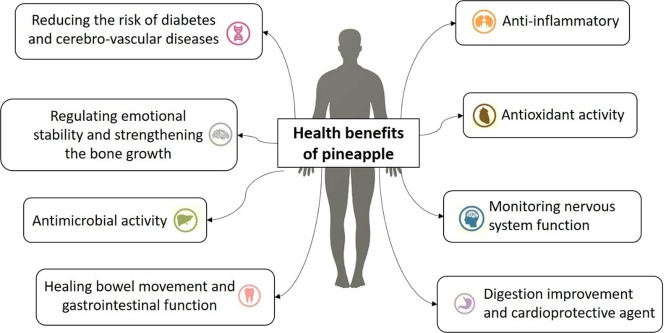
Pineapple (Ananas comosus) is a tropical fruit that is highly relished for its unique aroma and sweet taste. It is renowned as a flavourful fruit since it contains a number of volatile compounds in small amounts and complex mixtures. Pineapple is also a rich source of minerals and vitamins that offer a number of health benefits. Ranked third behind banana and citrus, the demand for pineapple has greatly increased within the international market. The growth of the pineapple industry in the utilisation of pineapple food-based processing products as well as waste processing has progressed rapidly worldwide. This review discusses the nutritional values, physicochemical composition and volatile compounds, as well as health benefits of pineapples. Pineapple contains considerable amounts of bioactive compounds, dietary fiber, minerals, and nutrients. In addition, pineapple has been proven to have various health benefits including anti-inflammatory, antioxidant activity, monitoring nervous system function, and healing bowel movement. The potential of food products and waste processing of pineapples are also highlighted. The future perspectives and challenges with regard to the potential uses of pineapple are critically addressed. From the review, it is proven that pineapples have various health benefits and are a potential breakthrough in the agricultural and food industries.
Graphical abstract
Introduction
Pineapple is a tropical fruit widely cultivated in South America which can either be consumed fresh or processed into various food products. It is ranked third in production of tropical fruit after banana and citrus. The pineapple market has been growing extensively due to the attractive aroma compounds and nutritional values as well as huge demand and competitive retail prices (Abu Bakar et al., 2013, Martínez et al., 2012). The top five pineapple producers worldwide in 2017 were reported as Costa Rica (3056.45 metric tons), Philippines (2671.71 metric tons), Brazil (2253.90 metric tons), Thailand (2153.18 metric tons), and India (1891.00 metric tons) (Statista, 2020). Pineapple is mainly cultivated in the tropical and sub-tropical regions due to the temperate climate and rainfall distribution. The crop can bear fruits at an early stage after flowering, allowing yield production throughout the year (Shamsudin, Zulkifli, & Kamarul Zaman, 2020). The shelf life of pineapple can be prolonged by storing the fruit under specific conditions and storage temperature as well as specific treatments to avoid microorganism contamination (Ismail, Abdullah, & Muhammad, 2018). In this context, a well-reasoned anticipation is to transform perishable fruits into staple products with a longer shelf life has been developed to reduce the qualitative quality deterioration of the fruit during storage.
Due to the high recognition of the nutritional and beneficial values in pineapples, it is a golden opportunity for fruit growers to gain access to domestic and international markets for the fruit. Maturity level, type of cultivar, climate conditions as well as postharvest handling are several factors that contribute to the chemical and biochemical properties present in pineapple (Ancos et al., 2016, Chaumpluk et al., 2012). Pineapple that is planted with good agricultural practice will produce fruit with excellent taste and aroma while fruit that is infected by pests and disease will produce fruits with off-flavours (Sipes & Wang, 2016). In recent years, pineapple has gained much attention since the nutritional composition has contributed to the potential uses as functional food and various pineapple-based products. A previous study done by Lasekan and Hussein (2018) identified that pineapples are rich in ester compounds including methyl-2-methylbutanoate, methyl hexanoate, methyl-3-(methylthiol)-propanoate, methyl octanoate, and 2-methoxy-4-vinyl phenol which are associated with the flavour quality of different types of pineapple varieties. In this sense, different maturity levels in pineapple results in changes in the chemical composition and different aroma profiles of the fruit, especially during storage.
Based on the physicochemical composition and nutritional values, pineapple can be considered as one of the most useful fruits for manufacturing value-added compounds such as antioxidants, organic acids, bromelain, and phenolic compounds. Barretto et al. (2013) extracted volatile compounds from the pineapple flesh to be utilised as aroma enhancing products as well as the production of natural essences. Likewise, the health benefits of pineapple are also associated with different phytochemicals and functional bioactivity to maintain the metabolism and improve human health (Hossain & Rahman, 2011). The typical bioactive compounds of pineapple are mainly phenolic compounds and flavonoids that are present in the morphological parts of the fruit (Lobo & Yahia, 2016). The health aspects involving the nutrient attributes of pineapple are the main consideration in developing the food-based and waste processing products. By taking advantage of the complete utilisation of pineapple, the potential for profitable goods either in the food industries and other sectors could provide a wide variety of food-based and waste processing products with high economic importance. Thus, the overall purpose of this review is to provide a comprehensive overview of the chemical composition, nutritional values, volatile compounds, health benefits, and potential uses of pineapples. With these findings, the food manufacturers and researchers may gain fundamental knowledge to explore new perspectives for pineapple products.
Access through your organization
Check access to the full text by signing in through your organization.
Section snippets
Pineapple physiology and characteristics
Pineapple is an exotic fruit that is highly valued due to its aroma, flavour, and juiciness. To date, there are many pineapple varieties with various colours, shapes, sizes, and flavours. Pineapple is a rather medium size compared to other tropical fruits which consist of multiple fruitlets with a distinctive maturation pattern from the top part near the crown until the bottom part of the fruit (Montero-Calderón, Rojas-Graü, & Martín-Belloso, 2010). Considering the fact that pineapple is a
Physicochemical composition and nutritional values
The increasing trend in pineapple production in the commercial line has been recognised due to its high concentration of phytochemical composition, nutritive potential, and the functional properties of the fruit. This scenario has led to advancement towards exploring the nutritional value as well as the physicochemical composition of pineapples. The exceptional feature of abundant nutrients and chemical composition are of interest to the food processing industries. This section discusses
Volatile compounds
Huge attention has been applied to the volatile composition of pineapple that plays a significant role in the sensory notes of fruit flavours. The diversity and distinctive flavour of pineapple represented comprehensive knowledge for continuing research into fruit aromas as well as attractive attributes for the consumers (Lasekan & Abbas, 2012). The aroma profile and volatile organic compounds of pineapple are beneficial for monitoring quality control of raw and pineapple-based processed
Potential food and waste processing of pineapples
The high nutritional value and abundant chemical composition of pineapple have attracted the interest of the food industries to incorporate into different food products. Further, the production and consumption of pineapple produces large volumes of solid wastes that in turn contribute to the possibility of valuable waste processing products. This section discusses the potential food-based and waste processing products related to pineapple as summarised in Table 4.
Health benefits
It is well known that adequate intake of nutrients is important for human health. Pineapple has been recognised to possess valuable bioactive compounds for medical purposes. The fruit is effective as a contraceptive, a diuretic as well as for the removal of intestinal worms (Hossain, 2016). In addition, pineapple is often used to increase appetite for food nourishment and boost the excretion of fat for topical debridement. As a source of bromelain, pineapple is used by substituting proteolytic
Future perspectives and challenges
Pineapple is a perishable and non-climacteric fruit due to the aroma and flavour quality. Even though pineapple is one of the major tropical fruits with a high consumption around the world, the preservation in terms of the freshness and quality over a long period is still required. The main concern for the pineapple commercial market is the limitation of the shelf life, especially the fresh-cut and minimally processed fruits. The fruit processing involving peeling, pruning, cutting, and slicing
Conclusions
The pineapple industry has huge potential for technological advancement in both domestic and international trade. Pineapples have become a profitable fruit in recent years in view of its unique aroma, abundant volatile compounds, and nutritional values. In this review, the physicochemical composition, nutritional values, volatile compounds, health benefits, as well as potential food-based and waste processing products of pineapple have been discussed. Apart from that, pineapple can be. source