

Maduro Captured by U.S. Military in under 5 hours – No Troops Lives Lost!
Spies, drones and blowtorches: How the US captured Maduro
Venezuelan President Nicolás Maduro and his wife arrived in New York on Saturday evening after the U.S. captured them overnight in a stunning escalation of the Trump administration’s push for a regime change.
Key Facts
Maduro and his wife Cilia Flores landed at Stewart Air National Guard Base in New York state just before 5 p.m. EST, multiple outlets reported.
Maduro landed in the U.S. after President Donald Trump declared “we’re going to run the country until such time we can do a safe, proper and judicious transition,” in an address to the nation Saturday afternoon.
He said “we’re going to have our very large United States oil companies, the biggest in the world, go in, spend billions of dollars and fix the badly broken infrastructure” in Venezuela, which holds the world’s largest oil reserves, among several comments Trump made suggesting the takeover is at least somewhat tied to the oil industry.
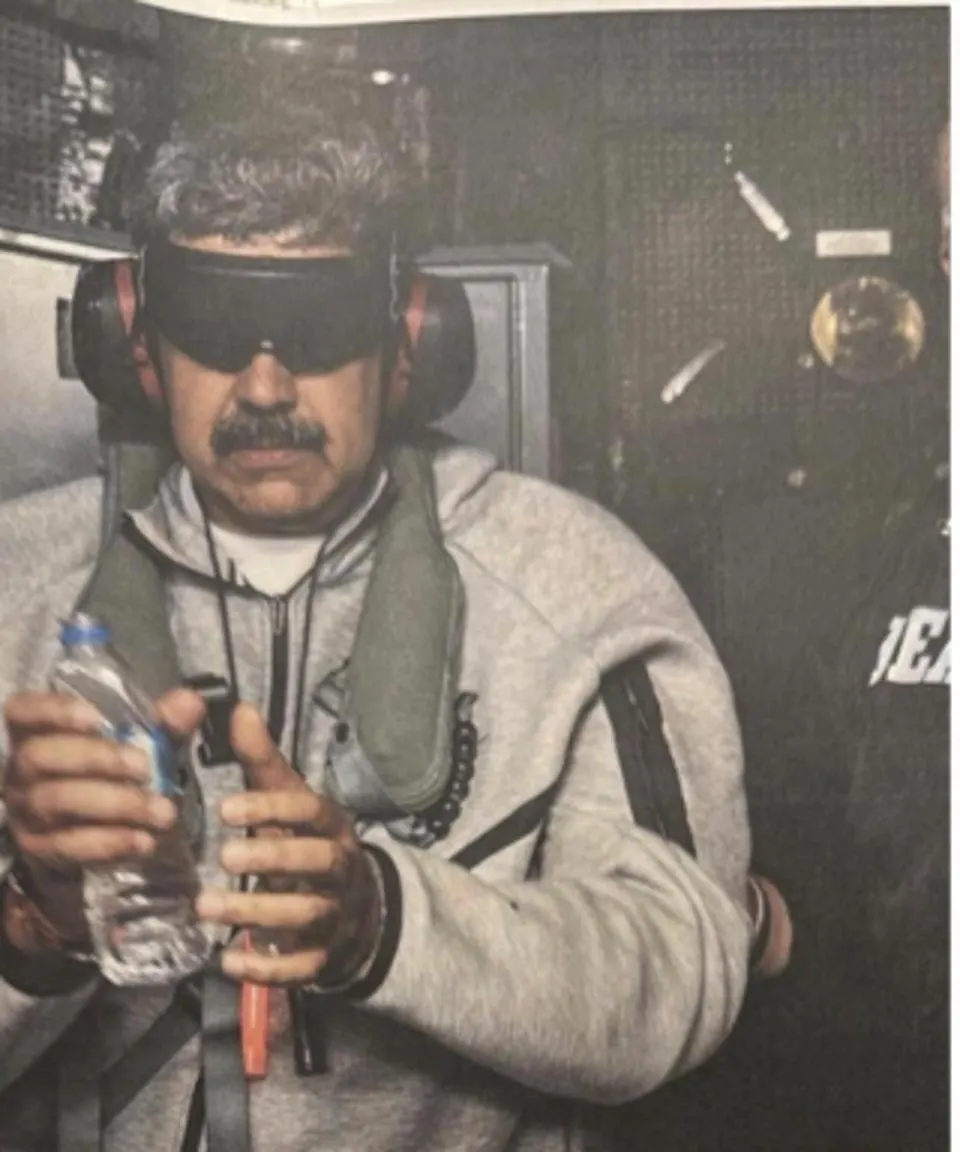
Just before delivering the address, Trump posted a photo of Maduro aboard the USS Iwo Jima wearing an eye covering, headphones, a gray tracksuit and holding a water bottle while a Drug Enforcement Administration agent is holding his arm.
Describing the operation, dubbed “Absolute Resolve,” Trump said “overwhelming American military power—air, land and sea—was used to launch a spectacular assault . . . like people have not seen since World War II” in action he said was designed to bring “outlaw dictator Nicolás Maduro to justice.”
Maduro was indicted in the Southern District of New York on charges of narco-terrorism conspiracy, cocaine importation conspiracy, possession of machine guns and destructive devices and conspiracy to possess machine guns and destructive devices, according to an unsealed indictment, the same four charges he faced in 2020, though the fresh indictment also names his son Nicolás Maduro Guerra and Flores as co-defendants.
For months, US spies had been monitoring Venezuelan President Nicolas Maduro’s every move.
A small team, including one source within the Venezuelan government, had been observing where the 63-year-old slept, what he ate, what he wore and even, according to top military officials, “his pets”.
Then, in early December, a planned mission dubbed “Operation Absolute Resolve” was finalised. It was the result of months of meticulous planning and rehearsals, which even included elite US troops creating an exact full-size replica of Maduro’s Caracas safe house to practise their entry routes.
The plan – which amounted to an extraordinary US military intervention in Latin America not seen since the Cold War – was closely guarded. Congress was not informed or consulted ahead of time. With the precise details set, top military officials simply had to wait for the optimal conditions to launch.
They wanted to maximise the element of surprise, officials said on Saturday. There was a false start four days earlier when US President Donald Trump gave approval, but they opted to wait for better weather and less cloud cover.
“Over the weeks through Christmas and New Year, the men and women of the United States military sat ready, patiently waiting for the right triggers to be met and the president to order us into action,” General Dan Caine, the nation’s highest-ranking military officer, told a news conference on Saturday morning.
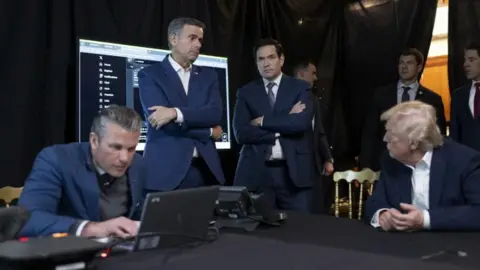
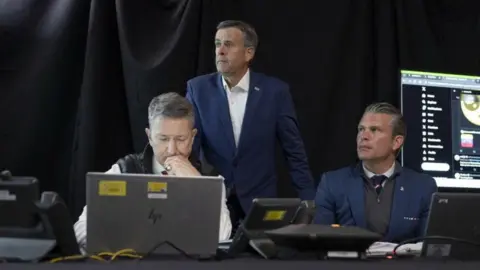
Trump did not follow the mission from the White House situation room. Instead, he was surrounded by his advisers at his Mar-a-Lago club in Palm Beach, Florida, where he watched a live stream of the operation flanked by CIA Director John Ratcliffe and US Secretary of State Marco Rubio.
“It was an incredible thing to see,” Trump said on Saturday. “If you would have seen what happened, I mean, I watched it literally like I was watching a television show. And if you would’ve seen the speed, the violence… it’s just, it was an amazing thing, an amazing job that these people did.”
In recent months, thousands of US troops have deployed to the region, joining an aircraft carrier and dozens of warships in the largest military build-up in decades as Trump has accused Maduro of drug-trafficking and narco-terrorism, and blown up dozens of small boats accused of ferrying drugs through the region.
But the first signs of Operation Absolute Resolve were in the skies. More than 150 aircraft – including bombers, fighter jets and reconnaissance planes – were ultimately deployed through the course of the night, according to US officials.
“It was very complex, extremely complex, the whole manoeuvre, the landings, the number of aircraft,” Trump told Fox News. “We had a fighter jet for every possible situation.”
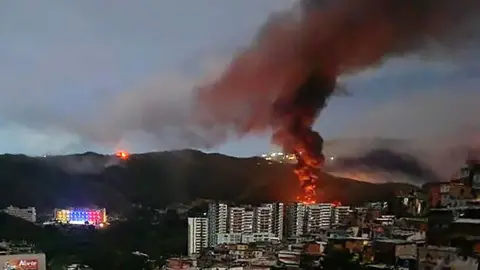
Loud explosions were heard in Caracas at about 02:00 local time (06:00 GMT), and plumes of smoke were seen rising over the city. “I heard a huge sound, a loud bang,” reporter Ana Vanessa Herrero told the BBC. “It moved all the windows. Immediately after I saw a huge cloud of smoke that almost blocked the entire view.”
She added: “Planes and helicopters were flying all over the city.”
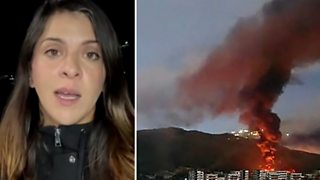
Soon, videos showing numerous aircraft in the skies – and others showing the apparent aftermath of explosions – began to circulate widely on social media. One showed a convoy of helicopters flying at low altitude over Caracas as smoke rose from apparent detonations.
“We woke up at around 01:55 to the roar of explosions and the hum of planes flying over Caracas,” one witness, Daniela, told the BBC. “Everything was plunged into absolute darkness, illuminated only by the flashes of nearby detonations.”
She added: “Neighbours were messaging in the condominium group chat, all confused and unaware of what was happening [and] frightened by the blasts.”
BBC Verify has examined a number of videos showing explosions, fire and smoke in locations around Caracas to identify exactly which sites were targeted.
So far, it has confirmed five locations including Generalissimo Francisco de Miranda Air Base, an airfield known as La Carlota and Port La Guaira, Caracas’ main conduit to the Caribbean Sea.

“The lights of Caracas were largely turned off due to a certain expertise that we have,” he said. “It was dark and it was deadly.”
‘They knew we were coming’
As strikes rang out around Caracas, US forces made their way into the city. They included members of the elite Delta Force, the US military’s top special mission unit, sources told the BBC’s US news partner CBS. They were heavily armed – and carried a blowtorch in case they had to cut through the metal doors of Maduro’s safe house.
The troops arrived at Maduro’s location shortly after the strikes began at 02:01 local time, according to Gen Caine. Trump described the safe house as a military “fortress” in the heart of Caracas, saying: “They were in a ready position waiting for us. They knew we were coming.”
The troops took fire when they arrived, and one of the US helicopters was hit but was still able to fly. “The apprehension force descended into Maduro’s compound and moved with speed, precision and discipline,” Gen Caine said.
“They just broke in, and they broke into places that were not really able to be broken into, you know, steel doors that were put there for just this reason,” Trump remarked.
It was only as the operation – which also saw Maduro’s wife, Cilia Flores, seized – was unfolding that Rubio began notifying lawmakers about the action, a decision which has since prompted anger from some in the US Congress.
“Let me be clear: Nicolas Maduro is an illegitimate dictator. But launching military action without congressional authorisation and without a credible plan for what comes next is reckless,” said top Democrat Chuck Schumer, the party’s leader in the Senate.
Briefing Congress ahead of time would have endangered the mission, Rubio told reporters during the news conference on Saturday. “Congress has a tendency to leak,” Trump added. “This would not be good.”
 Getty Images
In Maduro’s compound, as elite US troops flooded in, Trump said the Venezuelan president – who has reportedly increased his reliance on Cuban bodyguards in recent months – attempted to flee to a safe room.
“He was trying to get to a safe place, which wasn’t safe, because we would have had the door blown up in about 47 seconds,” Trump said.
“He made it to the door. He was unable to close it. He got bum rushed so fast that he didn’t get into that [room].”
When asked if the US could have killed Maduro, an authoritarian leader who took over the presidency in 2013, if he had resisted arrest, Trump said: “It could have happened.”
On the US side, “a couple of guys were hit”, he said, but no US service members were killed.
In a statement on Sunday, Venezuelan Defence Minister Vladimir Padrino said a “large part” of Maduro’s security team and “soldiers and innocent civilians” were killed in the US operation.
The US had previously offered a $50m (£37m) reward for information leading to Maduro’s arrest. But by 04:20 local time on Saturday, helicopters were leaving Venezuelan territory with Maduro and his wife on board, in custody of the US Department of Justice and en route ultimately to New York, where they are expected to face criminal charges.
Almost exactly an hour later Trump announced the news of his capture to the world. “Maduro and his wife will soon face the full might of American justice,” he said.
crucial Quote
“We’re not afraid of boots on the ground,” Trump said Saturday afternoon, in response to a question of whether U.S. troops will have a presence in Venezuela after Maduro’s capture. In a subsequent question about troop presence, Trump said “there would be a presence in Venezuela as it pertains to oil.” He said “we’re going to make sure that country is run properly” and “we’re designating people, we’re talking to people” to run Venezuela. He said Secretary of State Marco Rubio has spoken to Venezuelan Vice President Delcy Rodríguez, who was sworn in to take over for Maduro, and “she’s essentially willing to do what we think is necessary to make Venezuela great again.” Rodríguez contradicted Trump in an address later Saturday, insisting the Venezuelan government stands firmly behind Maduro, repeatedly calling him Venezuela’s “only president” and calling the attacks “an unprecedented military aggression.”
What We Don’t Know
It is unclear how long the U.S. will administer Venezuela, whether troops will end up being deployed to the country and exactly what the benchmark would be for the U.S. ending its direct oversight. Trump said Saturday that “a group” will run Venezuela, and though he did not state who would fully compose it, he motioned toward Rubio, Defense Secretary Pete Hegseth and Gen. Dan Caine and said it would “largely” be them “for a period of time.” It is not known who could lead after U.S. involvement ends, with Trump saying Nobel Peace Prize winner María Corina Machado—a Venezuelan opposition leader who voiced support for Maduro’s capture—lacks “the support or respect within the country” to be a successful leader. Trump also did not explicitly state which American oil companies could be involved in the Venezuela’s oil industry moving forward.
What To Watch For
Trump and Rubio suggested the actions in Venezuela should be considered a warning sign for other Latin American countries that have poor relations with the U.S., specifically Cuba and Colombia. “I think Cuba is going to be something we’ll end up talking about because Cuba is a failing nation right now,” Trump said in response to a question about whether there’s a message for Cuba. “If I lived in Havana and I was in the government, I’d be concerned,” Rubio, who is the son of Cuban immigrants, said. Trump also reiterated his comments that Colombian President Gustavo Petro, whom Trump has accused of sending cocaine into the U.S., “has to watch his ass.” Trump also mentioned Mexico in his Fox News interview Saturday morning, claiming Mexican President Claudia Sheinbaum “is not running Mexico” because “the cartels are running Mexico.” The president said the U.S. is “very friendly” with Sheinbaum, but “something’s going to have to be done with Mexico.”
Tangent
Trump warned Venezuelan officials in an interview with Fox News “if they stay loyal [to Maduro], the future is really bad, really bad for them,” but said “most of them have converted.” He also dismissed concerns being raised by some lawmakers that he did not seek proper congressional approval for the strikes, telling the network, “they should say ‘great job,’ they shouldn’t say ‘oh, gee, maybe it’s not constitutional.’ You know the same old stuff that we’ve been hearing for years and years and years.”
Key Background
Maduro and his wife were at their home in the Ft. Tiuna military base in Caracas when the U.S. “bombed” and “carried out what we would call a kidnapping of the president and the first lady of the country,” Venezuelan ruling party leader Nahum Fernández told the Associated Press. In addition to Caracas, the U.S. also conducted strikes in the states of Miranda, Aragua and La Guaira overnight, Venezuelan officials said. No U.S. military personnel were killed in the strikes, though Trump suggested several were injured when a helicopter was hit. The strikes follow a months-long U.S. military campaign against Venezuela the Trump administration has said is designed to target drug cartels. The U.S. has conducted dozens of strikes on vessels in the Caribbean it alleges were being used to smuggle narcotics into the U.S., killing more than 100 people. The U.S. military has also built up its presence in the Caribbean, intercepted Venezuelan oil tankers in recent weeks and conducted a drone strike on a dock in Venezuela last month, The New York Times previously reported. The U.S. views Maduro—whom the Trump administration has accused of being a “narco-terrorist”—as a fugitive and offered an award of up to $50 million for information leading to his arrest and/or conviction.


The White House