

Unearthed 1997 Wired Article Predicted The 21st Century With Insane Accuracy
In 1997, predictions for the future ranged from technological optimism for a “Long Boom” to concerns about increasing economic inequality and cyberwarfare. The internet was a dominant theme, though it was still in its early days, with most users on dial-up connections.
- The continued acceleration of Moore’s law and its impact on technological progress.
- The growth of handheld computing devices and mobile internet access.
- The expansion of the World Wide Web past 1 million websites.
- The eventual obsolescence of traditional advertising due to adaptation and dominance of new digital media.
- A miscalculation on how long it would take for computers to beat humans at the game of Go; one expert predicted it would take a century.
Key Predictions That Came True:
- Digital Currencies: The authors anticipated the rise of private, decentralized forms of money that would bypass governments — remarkably similar to Bitcoin and other cryptocurrencies.
- Decline of Nation-States: They predicted that as wealth and information moved online, traditional governments would lose control over money, taxation, and citizens who could operate globally through digital systems.
- Cybercrime & Cyber Warfare: They foresaw new forms of conflict in cyberspace, where power would shift from physical to digital battlegrounds.
- Remote Work & Digital Nomadism: The authors envisioned a future where highly skilled individuals could live and work anywhere, leveraging technology to achieve independence from centralized systems.
- Wealth Disparity & Political Polarization: They warned that technology would create new elites — “sovereign individuals” — while destabilizing traditional economic and political structures.
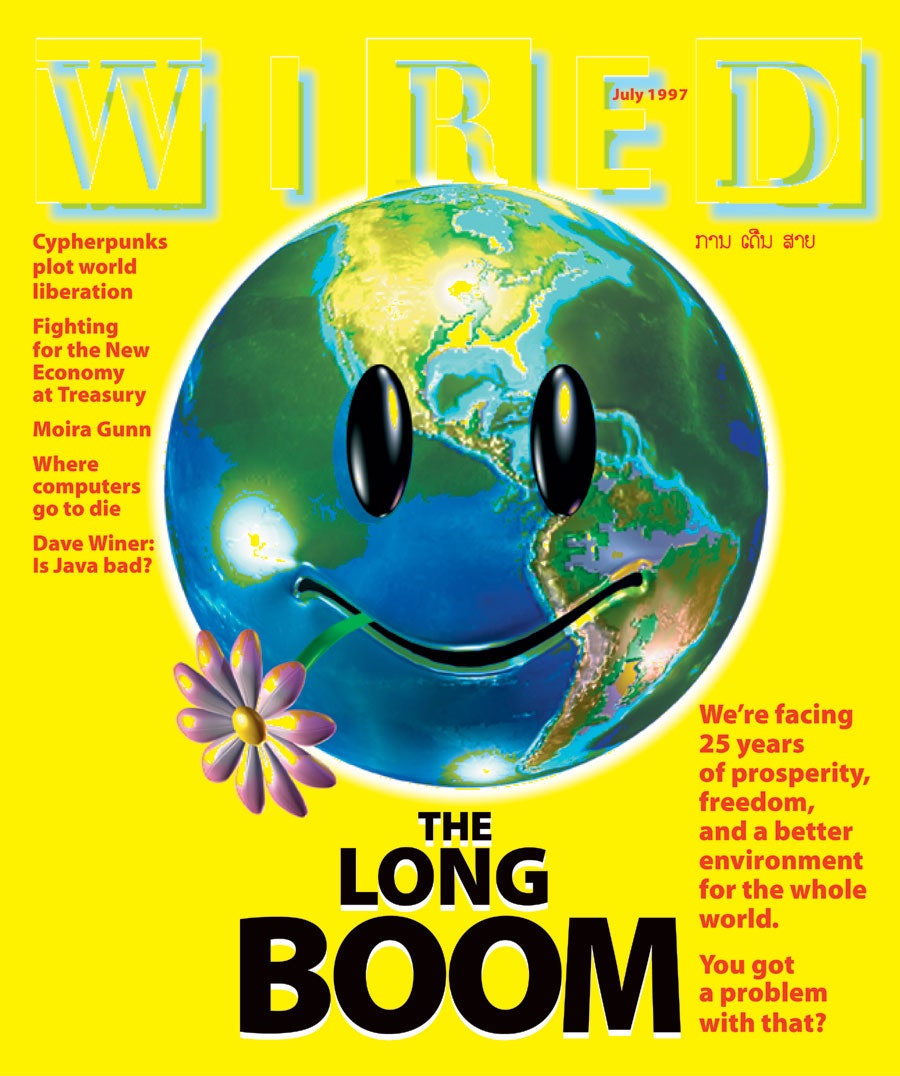
- Another 1997 warning came from Wired magazine’s July 1997 cover story, which predicted enormous technological progress but also flagged potential crises that could derail it — including pandemics, climate change, and soaring energy costs.
- Together, these 1997 insights painted a surprisingly accurate picture of the 21st century — an age of digital power, decentralization, and disruption that defines our world today.
The Long Boom: A History of the Future, 1980–2020
Predictions from Wired magazine
- Widespread economic expansion for 25 years.
- Increased prosperity and unprecedented opportunity.
- An improved environment.
- Opportunities for social justice.
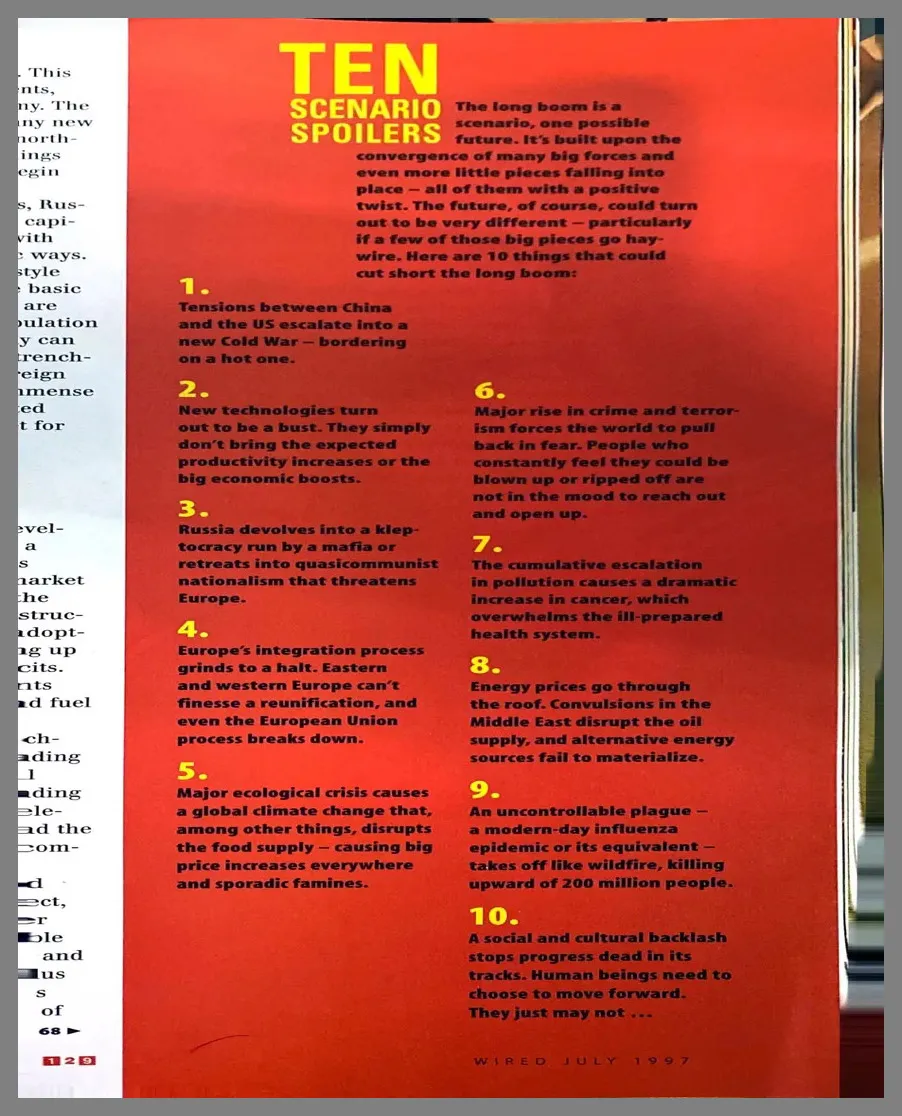
- A new Cold War between the U.S. and China.
- Technological busts that fail to deliver on promises.
- Russia’s descent into a kleptocracy or threatening nationalism.
- The breakdown of European integration.
- A major ecological crisis leading to climate change and food supply disruptions.
- A major rise in crime and terrorism causing society to retract.
- The overwhelming of health systems by dramatic increases in cancer due to pollution.
- Soaring energy prices.
- An uncontrollable plague that kills millions.
- A cultural backlash that halts progress.
In 1997, Wired Magazine Predicts 10 Things That Could Go Wrong in the 21st Century: “An Uncontrollable Plague,” Climate Crisis, Russia Becomes a Kleptocracy & More
Hydrogen-powered cars. Biological, then quantum computing. Gene-therapy cancer treatments. An end to the War on Drugs. Reliable automatic translation. The impending end of the nation-state. Man setting foot on Mars. These are just a few of the developments in store for our world by the year 2020 — or so, at any rate, predicts “The Long Boom,” the cover story of a 1997 issue of Wired magazine, the official organ of 1990s techno-optimism. “We’re facing 25 years of prosperity, freedom, and a better environment for the whole world,” declares the cover itself. “You got a problem with that?”
Since the actual year 2020, this image has been smirkingly re-circulated as a prime example of blinkered End-of-History triumphalism. From the vantage of 2021, it’s fair to say that the predictions of the article’s authors Peter Schwartz and Peter Leyden (who expanded their thesis into a 2000 book) went wide of the mark.
But their vision of the 21st century hasn’t proven risible in every aspect: a rising China, hybrid cars, video calls, and online grocery-shopping have become familiar enough hardly to merit comment, as has the internet’s status as “the main medium of the 21st century.” And who among us would describe the cost of university as anything but “absurd”?
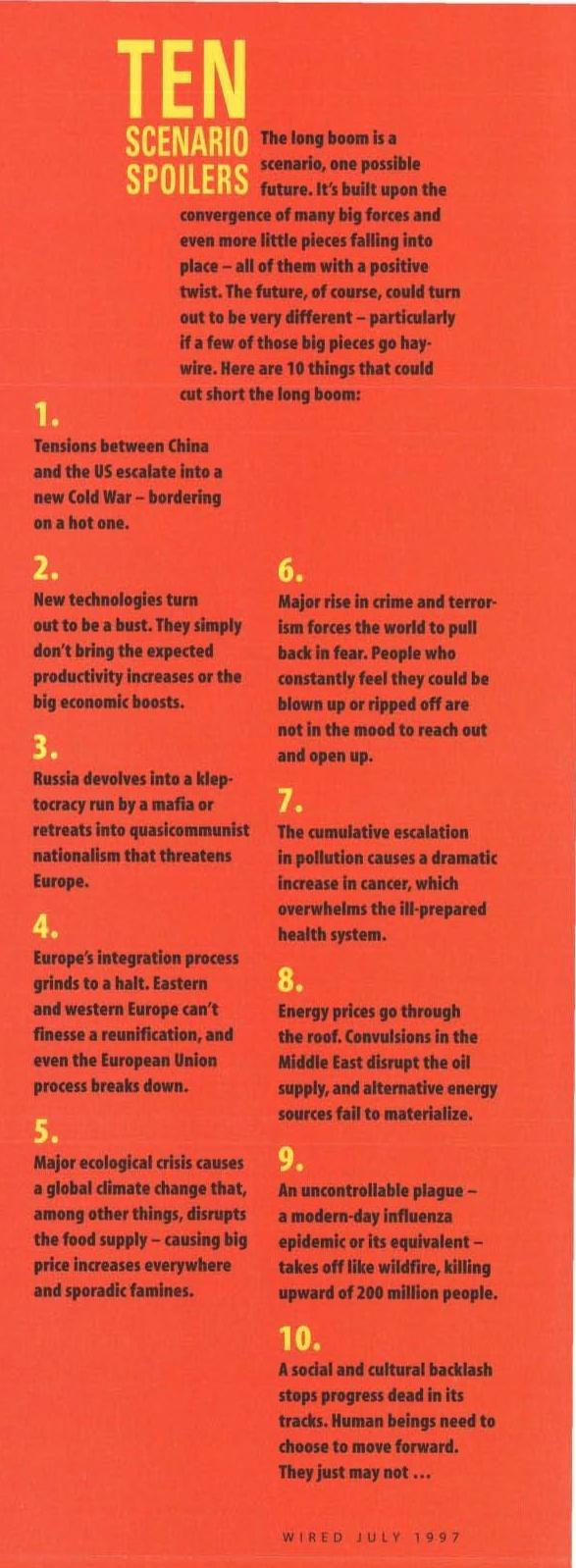
Schwartz and Leyden do allow for darker possibilities than their things-can-only-get-better rhetoric make it seem. Some of these they enumerate in a sidebar (remember sidebars?) headlined “Ten Scenario Spoilers.” Though not included in the article as archived on Wired’s web site, it has recently been scanned and posted to social media, with viral results. A “new Cold War” between the U.S. and China; a “global climate change that, among other things, disrupts the food supply”; a “major rise in crime and terrorism forces the world to pull back in fear”; an “uncontrollable plague — a modern-day influenza epidemic or its equivalent”: to one degree or another, every single one of these ten dire developments seems in our time to have come to pass.
“We’re still on the front edge of the great global boom,” we’re reminded in the piece’s conclusion. “A hell of a lot of things could go wrong.” You don’t say. Yet for all of the 21st-century troubles that few riding the wave of first-dot-com-boom utopianism would have credited, we today run the risk of seeing our world as too dystopian. Now as then, “the vast array of problems to solve and the sheer magnitude of the changes that need to take place are enough to make any global organization give up, any nation back down, any reasonable person curl up in a ball.” We could use a fresh infusion of what Schwartz and Leyden frame as the boom’s key ingredient: American optimism. “Americans don’t understand limits. They have boundless confidence in their ability to solve problems. And they have an amazing capacity to think they really can change the world.” In that particular sense, perhaps we all should become Americans after all.
in the same year A BOOK DID THE SAME!
The Sovereign Future: How a 1997 Book Accurately Predicted 2025
Predictions from The Sovereign Individual
- The decline of the nation-state: Governments were predicted to lose control as individuals and businesses adopted decentralized, digital systems.
- The rise of digital currencies: The authors foresaw private, decentralized money, an idea that aligns with modern cryptocurrencies like Bitcoin.
- The online economy and cybercrime: The book accurately predicted the growth of the online economy as well as the increase in cybercrime and cyber warfare.
- Social stratification: The authors predicted the internet would widen the gap between the “haves” and “have-nots”.
- The emergence of remote work and a “digital nomad” lifestyle.
- Disruption of traditional jobs: The book predicted that automation, AI, and global competition would make many traditional jobs obsolete.
- Changes in education: Digital content and online education were predicted to transform how learning is delivered.