

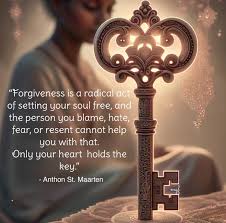
Forgiveness is the key to unlocking your true peace – The benefits of forgiveness
- Releasing Negative Emotions: Holding onto anger, resentment, and bitterness creates a heavy burden that hinders inner peace. Forgiveness is an active process of consciously releasing these negative feelings.
- Breaking the Cycle of Pain: Forgiveness can interrupt the cycle of anger and hurt, leading to a state of peace.
- Personal Growth and Healing: By choosing to forgive, you make room for healing and personal growth, enabling you to move forward without being defined by past pain.
- Reducing Stress: Research shows a strong link between forgiveness and reduced stress levels. This, in turn, can improve mental health outcomes like anxiety and depression.
- Improving Relationships: Forgiveness can help rebuild trust and open communication, fostering stronger and more supportive relationships.
-
The benefits of forgiveness:Forgiveness can lead to reduced stress, improved mental and physical health, stronger relationships, and a greater sense of inner peace and happiness.
-
Forgiveness and letting go: Forgiveness often involves letting go of the past and its associated pain, allowing one to focus on the present and future.
-
Forgiveness and personal growth: It can be a powerful catalyst for personal growth and transformation, helping individuals to heal, evolve, and move forward with a more positive outlook.
- Forgiveness does not mean forgetting or condoning the offense. It’s about letting go of the negative emotional and psychological impact of the offense on yourself.
- Forgiveness is a process that may require time and reflection.
Forgiveness is for us, not for them. For us to heal and move on but I really cant seem to do it. I get so angry every time I see my mom and I stay angry for a while. I hate the feelings it brings out of me.
Now my parents weren’t physically abusive but they were so unhappy in their marriage and their lives, they accidentally created shit childhoods for us.
I never felt loved or seen, there was only judgement and a sense of burdening them. Mom was angry at everything I did, she constantly complained about everything. She was a SAHM who did nothing to better herself or take care of her kids but she was judging the entire universe.
I see the impact of her choices on me and I see how much her own insecurities affected me and I cant help but think – why, why didn’t you better yourself? You had a lifetime and nothing else to do
If you have felt a similar way, what were the things that helped you forgive your parents?
Forgiveness Is the Key to Unlocking Your True Peace
Everyone experiences hurt – an inconsiderate friend, a betrayal, or worse – and the weight of grudges can be heavy. Increasingly, psychologists and even neuroscientists are finding truth in an age-old wisdom: forgiveness is the key to inner peace. Letting go of anger and resentment isn’t just a moral ideal celebrated by spiritual traditions; it’s a practical strategy for emotional freedom, better health, and resilience. “Forgive us our debts, as we forgive our debtors,” an ancient prayer intones, recognizing that forgiving others is crucial for our own well-being. Modern research agrees. Holding onto bitterness elevates stress, blood pressure, and anxiety, while choosing to forgive can lower stress hormones, improve mental clarity, and even rewire the brain for the better. This article explores forgiveness from a broad perspective – its psychological and physical benefits, its reflection in both secular and spiritual wisdom, and how real people have achieved personal peace by forgiving. By the end, you’ll see why turning the key of forgiveness unlocks true peace in your mind and life.
Why Letting Go is Good for You (Understanding Forgiveness)
Forgiveness is often misunderstood. It does not mean forgetting what happened, condoning the harm, or reconciling with an abuser. Rather, psychologists define forgiveness as a conscious choice to release feelings of anger, resentment, or vengeance toward someone who hurt you, whether they deserve it or not. It’s “replacing ill will toward an offender with goodwill,” as one Harvard expert puts ithealth.harvard.edu. In essence, you decide to cancel the “debt” of the offense so that it no longer controls your life. This act is fundamentally for your benefit – the other person may never even know you forgave them.
Why go through this difficult process? Because refusing to forgive keeps you stuck in a cycle of stress and pain. Ruminating over past wrongs triggers the body’s stress response each time: heart rate and blood pressure spike, muscles tense, and emotions churn with anger or sadness. Over time, this state of unforgiveness can take a serious toll on mental and physical health. In fact, remaining in a hostile, resentful state has been likened to a wound that never heals. “Feeling stuck in hostility can torment us mentally,” causing “intense rumination – a looping of negative thoughts”health.harvard.edu. We relive the hurt repeatedly, which impedes our ability to move forward. On the flip side, forgiveness allows us to finally exhale that toxic anger. It’s an emotional release – a way of saying “I’m not going to let this grievance dominate my life anymore.” As the Greater Good Science Center reports, forgiving someone engages brain regions that “empower you to step beyond painful experiences in an energized, motivated, and connected way.” It actually builds resilience and strengthgreatergood.berkeley.edu. In choosing to forgive, you free yourself from the grip of the past. The result is often a profound sense of peace and freedom, as countless individuals attest.
Psychological Benefits of Forgiveness (Healing the Mind)
Modern psychology has amassed substantial evidence that forgiveness benefits mental health. Whether through formal forgiveness training or personal practice, letting go of grudges has been shown to produce positive changes in mood and mindset. A 2023 multi-country study led by Harvard researchers found that when people actively learned how to forgive, they saw significant reductions in depression and anxiety symptoms compared to a control grouphealth.harvard.eduwashingtonpost.com. In fact, forgiving was so impactful that researchers suggested it as a public health intervention for improving mental well-beingwashingtonpost.com. Here are some key psychological benefits highlighted by recent studies and experts:
-
Less anxiety and depression: Across five countries, those who practiced forgiveness reported feeling less anxious and less depressed than beforehealth.harvard.edu. By releasing resentment, they alleviated emotional burdens that fuel mental distress. Other research concurs that forgiveness therapy leads to fewer symptoms of depression and anxiety and greater feelings of hope for the futurepmc.ncbi.nlm.nih.gov.
-
Reduced anger and stress: It’s no surprise that forgiving someone reduces anger – you’re letting go of the grudge, after all. But importantly, this also lowers chronic stress. Psychologists note that holding onto anger puts your body in a state of tension. When you forgive, you switch off that “fight or flight” response, often experiencing immediate relief and calm. Over time, this can break the cycle of rumination (repeatedly revisiting the hurt), which frees your mind to focus on more positive things.
-
Improved self-esteem and mental clarity: Remarkably, studies have found that as people forgive, their self-esteem tends to risepmc.ncbi.nlm.nih.gov. Why? Forgiveness empowers you – you’re no longer a victim of the offense, but a victor over the negative emotions associated with it. This positive shift can boost confidence and clarity. Many report that after forgiving, they feel lighter, as if a mental fog has lifted. Decisions come easier, and they regain a sense of control over their emotions rather than feeling controlled by past pain.
-
Greater resilience: Forgiveness doesn’t just help you heal from this hurt; it can build resilience to face future challenges. Brain imaging studies reveal that forgiving engages brain pathways associated with problem-solving, empathy, and emotional regulationgreatergood.berkeley.edu. Essentially, practicing forgiveness is like a workout for your brain’s “resilience muscles,” teaching you how to cope with adversity in a healthy way. Over time, people who cultivate forgiveness often bounce back faster from setbacks and exhibit more optimism in difficult situations.
In sum, forgiveness is therapeutic. As one researcher noted, “When we learn to forgive others, we simultaneously heal ourselves.”pmc.ncbi.nlm.nih.gov By cleaning the wound of old anger, we prevent further infection of our psyche. What’s left is a mind at peace, better equipped to experience joy and engage fully with life.
Physical Health Benefits of Forgiveness (Healing the Body)
The body responds dramatically to our emotional state. Harboring grudges has been linked to physical stress ailments, while forgiving can trigger physiological healing. Science is now catching up to this wisdom. According to a review of studies, forgiveness contributes to lower blood pressure, better sleep quality, and even a stronger immune systemwashingtonpost.com. Here are some notable physical health benefits:
-
Heart health and blood pressure: The act of forgiveness has a calming effect on the cardiovascular system. In moments of anger or recalling a grudge, your blood pressure spikes and heart beats faster. Chronic unforgiveness keeps you in this state, which over time can damage arteries and strain the heart. Forgiving, however, can “lower blood pressure and heart rate,” effectively reducing cardiovascular strainhealth.harvard.edu. Some studies found that people who let go of grudges showed improvements in hypertension (high blood pressure) readings. Simply put, a peaceful heart tends to be a healthier heart.
-
Stress reduction and immunity: Emotional stress from resentment can suppress your immune function, making you more vulnerable to illness. By releasing resentment, you dial down the body’s stress hormones (like cortisol). Lower stress can improve everything from digestion to immune response. Many individuals report that after forgiving, they feel fewer physical symptoms of stress – for example, tension headaches or muscle pain might diminish as the body relaxes. Over the long term, this means fewer stress-related ailments. In fact, researchers in one study noted that people stuck in unforgiveness showed higher physiological stress responses, whereas those practicing forgiveness had more normalized stress levelshealth.harvard.edu.
-
Better sleep and energy: Ever lain awake stewing over how someone wronged you? Grudges are exhausting. Forgiveness, on the other hand, is associated with better sleep. A 2019 study in Psychology & Health found that those who scored higher on forgiveness measures tended to have better sleep quality and less fatigue than those who held grudges. By resolving inner conflicts, forgiveness quiets the mind at night, leading to more restful sleep. In turn, improved sleep boosts your daytime energy and concentration. It’s a virtuous cycle: peace of mind yields peaceful sleep, which yields a healthier, more energetic you.
-
Longer lifespan and overall wellness: While research is ongoing, some evidence suggests that forgiving might even contribute to longevity. Chronic anger and hostility have been identified as risk factors for health conditions that shorten life (like heart disease). Conversely, people who forgive more readily often have lower inflammation levels and healthier lifestyles (since they may cope through positive means rather than substance abuse or overeating out of stress). All these factors can add up to a longer, healthier life. As one health publication put it, forgiveness is “not just good for the soul,” it’s good for the body toohealth.harvard.edu.
The takeaway is clear: your body listens to your heart. By purging bitterness from your heart, you also purge toxins from your body. Medical clinics, including the renowned Mayo Clinic, now advocate forgiveness as part of a holistic approach to wellness, citing benefits like lower blood pressure, less anxiety, and reduced chronic pain. In summary, forgiveness is a mind-body medicine – free to use, with only positive side effects!
The Spiritual Dimension of Forgiveness (Universal Wisdom)
Even in a secular discussion, it’s worth noting that forgiveness has deep spiritual and cultural roots. Virtually every major religion and moral philosophy extols the virtue of forgiving others. This isn’t a coincidence; across time and culture, people observed that forgiveness leads to inner freedom and social harmony. For example, Christian scripture teaches, “Do not judge… do not condemn… Forgive, and you will be forgiven.” (Luke 6:37biblehub.com). In Judaism and Islam, forgiving others is highly honored, and withholding forgiveness is seen as corrosive to the soul. Buddhism advocates compassion and letting go of anger as a path to enlightenment. Secular humanist thinkers, too, recognize the transformative power of forgiveness in conflict resolution and personal growth.
What all these traditions share is the understanding that holding hate only hurts the hater. Forgiveness, by contrast, is often described as liberation. It frees your spirit from the burden of past injuries. Many who forgive describe feeling lighter or as if “a weight was lifted” off them – imagery common to spiritual rebirth. In a broader sense, forgiveness can also mend the social fabric. When we forgive, we break cycles of retaliation and revenge that cause endless suffering. This is why leaders like Martin Luther King Jr. and Mahatma Gandhi, though leading secular movements, spoke frequently about forgiveness and love as powerful forces for change.
Importantly, you don’t have to follow a particular faith to appreciate the inner transformation forgiveness brings. However, for some, spiritual beliefs can provide strength in the forgiveness journey. They might find it helpful to reflect on their own imperfections and how they’d want to be forgiven (echoing the Golden Rule). Others draw on concepts like karma or divine grace to release their grudges. Even without religious context, one might frame forgiveness as aligning with your highest self – choosing empathy and peace over anger. Ultimately, whether one views it as a divine command or simply wise living, forgiving others is a profound act of self-care and virtue recognized worldwide. It connects us to something larger – be it community, humanity, or a sense of higher purpose – by dissolving the walls that resentment builds between us.
Real-Life Story: Finding Personal Peace Through Forgiveness
To see how forgiveness can unlock true peace, consider the remarkable story of Mary Johnson. Mary is a woman from Minneapolis whose only son was tragically murdered in 1993 by a teen named Oshea. Understandably, Mary was consumed by grief and bitterness after her son’s death. “I was angry and resentful,” she admitted – the thought of forgiving the killer seemed impossible at first. Oshea went to prison, but Mary remained a prisoner of her own rage for over a decade. Seventeen years later, still without peace, Mary felt led to meet Oshea face-to-face. She says her faith and desire to move forward pushed her to do this. The meeting, held in the prison visiting room, was life-changing. Oshea sincerely apologized for what he had done and, with tears, asked Mary for forgiveness. In that pivotal moment, Mary chose to let go of the hatred she’d harbored. As they cautiously embraced, she recalls, “I just hugged the man that murdered my son… and I instantly knew that all anger and animosity… was over.”prisonfellowship.org The burden she’d carried for years melted away in an instant of mercy.
Mary Johnson’s act of forgiveness not only brought her inner peace – it also sparked an unlikely friendship. After Oshea served his sentence, Mary welcomed him back to society. In fact, he eventually moved into the apartment next door to Mary, with her blessingprisonfellowship.org. She began referring to Oshea as her “spiritual son,” saying, “I forgave him and gained a son”. In 2010, when Mary remarried, Oshea was even the one who walked her down the aisleprisonfellowship.orgprisonfellowship.org. The two now frequently share their story together at community events, showing the world that reconciliation and healing are possible. Mary went on to found an organization called From Death to Life, which helps others impacted by violence to find healing through forgivenessprisonfellowship.org.
Mary’s journey illustrates that forgiveness is not about the offender deserving it – it’s about you deserving peace. By forgiving the young man who took her son’s life, she released herself from a prison of bitterness. The transformation was tangible: her blood pressure dropped, her depression lifted, and she smiled again. “Forgiveness freed both the one forgiven and the one forgiving from the bondage of the past,” as one article noted about Mary’s experienceprisonfellowship.org. Indeed, both she and Oshea were able to move forward and find purpose beyond the tragedy. Not every story of forgiveness will end in such a beautiful friendship, but Mary’s example shows that even the deepest wounds can be healed. The key was her willingness to let go for her own sake, to trade rage for serenity. In doing so, she unlocked a life of peace that had been sealed away by resentment.
Forgiveness is the key – whether viewed through the lens of science, psychology, or spirituality, this truth stands. Letting go of anger might be hard, but it is one of the most liberating choices we can make. It clears out the negativity occupying our hearts and minds, making room for peace, joy, and connection. As you consider your own life, ask: is there a past hurt that still locks up a part of you? By turning the key of forgiveness, you open the door to freedom. The path may not be easy, but on the other side lies the true peace we all deserve. Embrace forgiveness – for your health, your happiness, and your future. The sooner you do, the sooner you’ll step into the lightness and relief that comes from a heart unburdened, finally at peace. pureflix.comprisonfellowship.org