

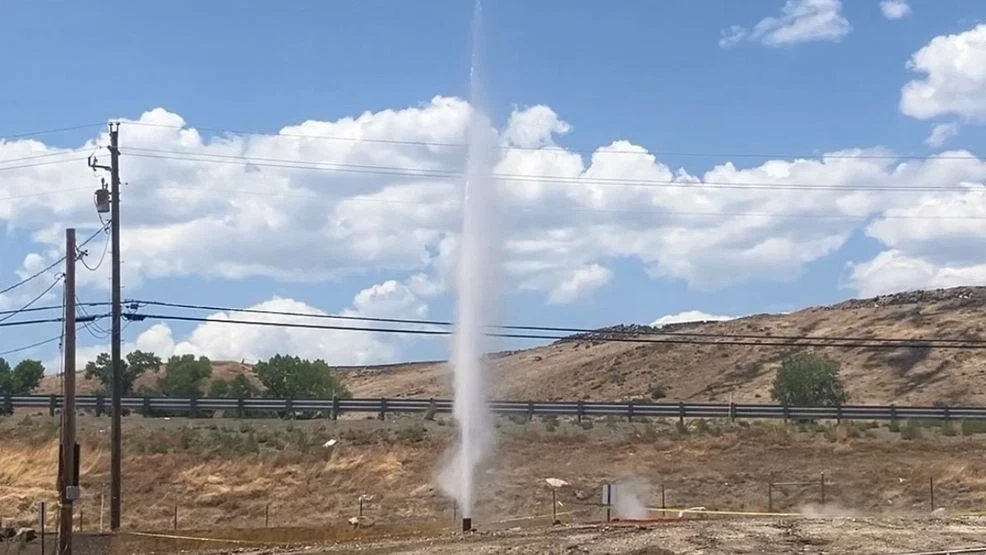
Steamboat Hotsprings Geyser erupta 30-foot boiling water in South Reno
RENO, Nev. (News 4 & Fox 11) — Not since the days of Mark Twain has there been anything like what people witnessed in the Steamboat area of south Reno this month — a geyser shooting scalding water 30 feet into the air.
The natural phenomenon attracted curiosity seekers and scientists alike, hoping to catch a glimpse of the most spectacular geyser activity reported in the area since the 1800s.
“I’ve never been to Yellowstone. But for me, this is like a real close second,” said Rachel Micander, a geologic information specialist with the Nevada Bureau of Mines and Geology.
In the 1800s, Steamboat was estimated to be the third-largest geyser field in the United States. During the 20th century, much of that activity went underground, until just recently, when mineral-rich water started percolating through the surface once again
But in early June, the geyser reemerged, spouting water out from an abandoned geothermal well. Today, the geyser has subsided, but the area is still geothermally active, with several small pots bubbling up nearby.

Geologists are actively studying the area, visiting it often to observe, take water and rock samples and monitor the temperature with probes. Cary Lindsey, research geologist with the Nevada Bureau of Mines and Geology, said she wants to find the answer to the ‘million-dollar question’ — what caused the geyser?
“It could be a lot of things … there’s been a change in the water table in South Reno, when this area moved from more agriculture to more housing. The water table may have risen,” Lindsey said. “We could have had a little micro-earthquake and it could have shaken one of those fluid channels.”
There is geothermal production in the area. We’re not ruling that out but we’re not really looking at that as the primary cause either. We are just leaving all of our options open.
Though what caused the geyser to erupt is an open question, what caused it to since subside may have had something to do with Phil Busick, who owns the land on which it sits.
“There’s a neighbor of mine right over here who has one in his backyard. A very smart guy, he helped us,” Busick said. “We poured cold water just through a garden hose off the building … we stood back a few feet and fed it down the hole and let the water run. And after a half hour to an hour, it settled down.”
It’s kind of neat. You know, it is a natural phenomenon. Not everybody has a geyser or a fissure bubbling hot water in their backyard. So it is something special.

The Silver State is one of the most geothermally active areas in the U.S. — it’s perfectly located for such activity because it’s positioned near two tectonic plates, making the Earth’s crust relatively thin.
“Here in western Nevada, that crust is thin enough and that magma is close enough to the surface that it can heat the groundwater as it enters deep into the Earth along these fractures,” local nuclear physicist Taylor Wilson told us last year. source
Disclaimer: Most of the geothermal activity is on private property near the Steamboat Hot Springs. It is blocked off with ‘no trespassing’ and ‘private property’ signs. The water is also over 200 degrees and the ground could be unstable, so experts say it is dangerous and that people should stay away.
It’s a fitful, intermittent eruption that’s happening for a 30-foot ‘geyser’ spouting boiling water on a small property off Alternate 395 South Virginia Street.
The water is coming from a pipe next to a long fissure in the ground – a fissure that geologists started studying last year when it became home to a collection of springs spewing hot bubbling water, less than a foot tall.
“The fissure has been there for a very long time, but it’s been dry,” Rachel Micander, Geologic Information Specialist with the Nevada Bureau of Mines and Geology, explained to 2 News Nevada on Friday. “Last year, in March, we came down and noticed that it was doing what we call perpetual spouting – there was this water, boiling water, coming out of the ground, spouting. Jim Faulds called it a mini geyser.”
She and other scientists studying the area believe that this new geyser is connected to those bubbling water spouts.
It began erupting Sunday afternoon, June 1, and spouted water for about 24 hours by resident reports, before the area completely dried up – including the small spouts nearby. As of Thursday night, it’s erupting again.
Though it’s an interesting and scientifically significant sight, scientists are warning the community not to visit. Micander measured the water temperature at 95 degrees Celsius – over 200 degrees Fahrenheit.
“This can cause third-degree burns. It can kill you,” she said. “Also, the ground in that area is incredibly unstable. There’s hot water flowing all underneath it, and because this geyser is unpredictable, the ground is unpredictable.”
Micander and other geologists aren’t sure what’s behind the geyser activity. She’s currently studying documents outlining the property’s history and permits, to see if they hold clues to what’s facilitating the water’s path to the surface now.
Contrary to rumors, she and other scientists don’t believe that the geyser activity is connected to the geothermal plant up the street, operated by Ormat Technologies. According to Micander, Ormat operates on a closed system at a higher elevation – the water that’s pumped out is reinjected.
The geysers at Steamboat have also been around for decades more, and disappeared long before any geothermal activity nearby. Eruptions weren’t uncommon a century ago. Why the land dried up, and why the water is returning now are questions that Micander and others are studying.
“Geysers operate on a very delicate system. They have things that they need to do geyser things, and if one of those things is out of whack – it could be water, it could be pressure, it could be heat – then you’re not going to have a geyser,” she said.
After the site dried out on Tuesday, Micander almost thought that was the last of it – that South Reno’s geysers had officially disappeared once again. But as long as this new, impressive spout continues to erupt, it may hold more clues to the history and future of the hot water just beneath the South Reno’s surface. source