

How Phones are Destroying our Relationships and Communication
Phones are damaging relationships by causing technoference, which is the constant distraction and interruption of face-to-face interactions, leading to reduced feelings of closeness, trust, and satisfaction. This behavior, known as “phubbing,” communicates a lack of interest or importance, causing partners to feel unheard and ignored. Excessive phone use can also fuel jealousy and insecurity, potentially leading to more serious issues like emotional or physical infidelity and even divorce.
How Phones are Destroying our Relationships and Communication
- “Phubbing” lowers relationship quality. Phubbing, or phone-snubbing, is the habit of ignoring someone in a social setting in favor of your mobile phone. A study found that when a mobile device is present during a meaningful conversation, people rate their experience as less fulfilling and their partner as less empathetic. Research also reveals that being phubbed triggers feelings of exclusion and reduced self-worth, which decreases relationship satisfaction.
- Lost nonverbal cues. In-person conversations are richer because they include nonverbal signals like facial expressions, body language, and eye contact. These are often lost or overlooked when a person is distracted by their phone, which makes it harder to understand emotions and build connection.
- Presence is compromised. Just having a phone visible during a face-to-face conversation, even if not in use, can interfere with a sense of connection and closeness. When attention is divided, the opportunity for true, authentic connection is lost.
- Texting leads to misinterpretation. Communication through text messages lacks tone, inflection, and other cues, making it easy to misinterpret meaning and cause misunderstandings or conflict.
- “Technoference” causes arguments. The interference of technology in relationships, termed “technoference,” can cause frequent conflict. Partners often fight over excessive phone usage, leading to feelings of neglect when a conversation is interrupted by a text or notification.
- Creates “alone togetherness.” This term describes when two people are physically together but mentally absorbed in their phones, leading to shallow and less meaningful interactions. A study found that 62% of couples reported technology interfering with their daily time together.
- Parents distracted from their children. Parents who are preoccupied with their phones speak to their children less and are slower to respond to their needs. A study on playgrounds found that a majority of parents on their phones did not respond to their children’s calls for attention. This can cause children to feel neglected and can interfere with their developmental milestones like communication and socialization skills.
- Causes jealousy and comparison. Social media creates a platform for comparing one’s relationship to the “highlight reels” of others, which can lead to jealousy, insecurity, and dissatisfaction. This can lead to a feedback loop of mistrust, as partners monitor each other’s online activity.
- Reinforces addictive behavior. The constant checking of phones is reinforced by small “dopamine hits” from notifications and social media engagement. This can lead to a compulsive habit where individuals prioritize online interactions over real-life connections.
- Increases loneliness. Paradoxically, constant online connection can make people feel more lonely. A Facebook study showed that passive viewing of other people’s posts decreases happiness, while other studies have linked social media to increased loneliness and depression.
-
Reduced Communication and Connection:Studies show that the mere presence of a phone during a conversation decreases the quality of communication and connection, even without conscious awareness.
-
Phubbing and Lack of Attention:When people prioritize their phones over their partners, it’s perceived as “phubbing,” which makes the other person feel unimportant and unacknowledged.
-
Increased Conflict and Insecurity:Constant phone interruptions can lead to arguments and feelings of insecurity about the relationship and one’s own worth.
-
Decreased Satisfaction and Well-being:Research indicates that phone-related distractions can lower relationship satisfaction and overall well-being.
-
Erosion of Intimacy:Fragmented communication and lack of attention can weaken emotional bonds and inhibit true intimacy between partners.
-
Infidelity and Divorce:Excessive smartphone use has been linked to an increase in emotional and physical affairs, which can destabilize marriages and contribute to divorce.
-
Lower Trust and Confidence:A partner’s over-reliance on their phone can erode trust and confidence in the relationship, as they may feel their partner is more invested in their device.
-
Jealousy and Envy:Comparing one’s relationship to the curated lives of others on social media can create envy and negatively impact a relationship.
-
Create Boundaries:Establish clear rules for phone use, such as designated “phone-free” times or zones, especially during meals or important conversations.
-
Prioritize In-Person Interaction:Make a conscious effort to put phones away and give your partner your undivided attention to foster closeness and authentic connection.
-
Communicate Your Needs: Speak with your partner about how phone use affects you and work together to find solutions that respect both of your needs.
-
Practice Mindful Phone Use: Be more aware of the implicit messages you send when you’re distracted by your phone and the negative impact it can have on your relationships.
A phone becomes a “key partner” when its role in a relationship shifts from a useful tool to a central, often problematic, presence that can detract from in-person interaction and satisfaction. Excessive phone use, known as “partner phubbing” (phone snubbing), can lead to feelings of neglect, conflict, and decreased intimacy. However, phones can also be a valuable partner by facilitating communication, providing support, and helping couples connect through shared activities and text-based exchanges, if used mindfully and in balance with face-to-face time.
-
The term “technoference” describes how technology interferes with relationships, with phubbing – ignoring your partner to focus on your phone – causing feelings of exclusion, reduced responsiveness, and jealousy.
-
Decreased Relationship Satisfaction:Studies show that excessive phone use can decrease marital and relationship satisfaction, leading to feelings of neglect, rejection, and loneliness for the partner who feels ignored.
-
Conflict and Anxiety:Constant phone use can create tension and arguments within a relationship, and the anxiety-inducing nature of constant checking can erode the quality of time spent together.
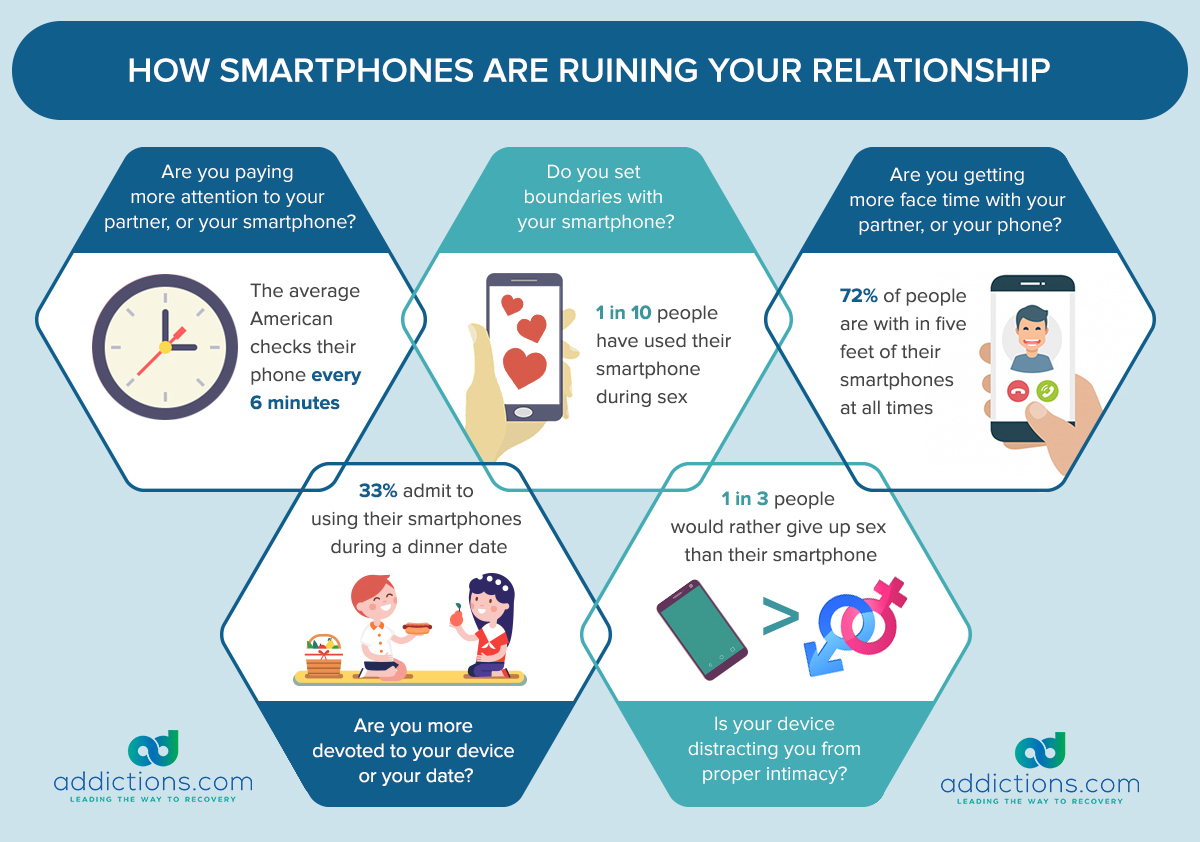
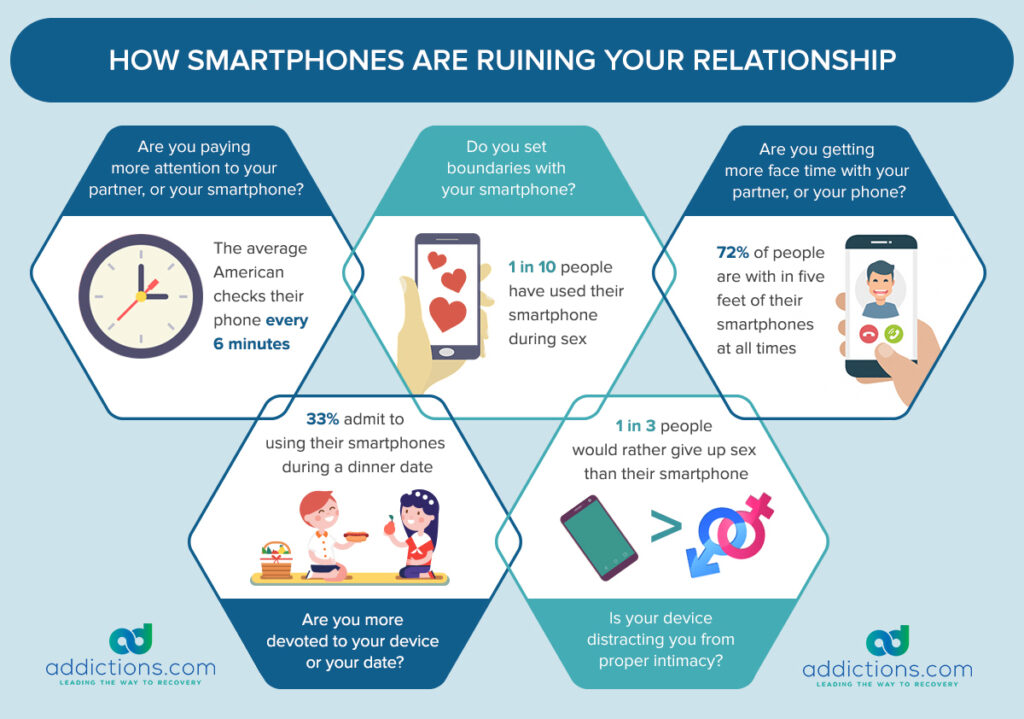
Americans check their smartphones approximately an average of 205 times a day. It seems that almost everyone is dependent on their smartphone. According to one survey, 76% of U.S. adults get nervous if they can’t find theirs, and 44% say they couldn’t go one day without it.
Smartphone dependency and smartphone addiction are taking a toll on relationships everywhere, and some would even pick their device over the relationship if forced to choose between the two. A recent study found that one-third of individuals would rather give up sex than their smartphones.
This dependency is so widespread, partly because very few people have the choice to “opt out” of internet life and all the accompanying devices. Our work, social, and family lives depend upon email, texts, and internet access, and we are expected to be able to connect to these things at all times through our smartphones. This means we carry our addiction triggers with us everywhere we go—we have to.
In some ways, smartphones can enhance relationships. The ease of staying in touch with a partner through texts, calls, and FaceTime can strengthen relationship bonds by maintaining intimacy through busy days and long distances. On the other hand, people have difficulty truly connecting face to face when one or both partners are distracted by the constant urge to check their phone.
People today use their smartphones all the time, everywhere. The survey found they’re spending an average of five hours and 16 minutes per day staring into a screen.
Naturally, this degree of smartphone obsession gets in the way of intimacy.
Seven Ways That Smartphone Addiction is Getting in the Way of Your Relationship
1. Phubbing
This mashup term derived from “phone-snubbing,” refers to times when you become distracted by your phone, and your partner feels snubbed or rejected. It has become one of the major sources of relationship conflict in recent years.
2. Miscommunication
When you are constantly distracted by your phone, you’re more likely to miss what your partner is saying. This will not only show thoughtlessness towards your partner, it can lead to misunderstandings and miscommunications that can cause all kinds of problems—from failing to show up to an event your partner thought you’d agreed to come to, to failing to recognize when your partner is trying to tell you something important, and responding inappropriately or not at all.
3. Time and energy drain
Smartphone overuse can be a major drain on time and energy that you could be spending on your partner. It can result in a pattern of consistent neglect that drives a wedge between you.
4. Less sex, and/or worse sex
Many people report not wanting to stop what they’re doing on their smartphone to have sex with their partners, and one in five people actually checks their phone during sex.
5. More insecurity and less satisfaction
Individuals with smartphone-dependent or addicted partners could be less happy in their relationships. The higher the level of smartphone dependency within a couple, the higher the level of relationship uncertainty, and the lower the level of relationship satisfaction.
6. Self-centeredness
Spending a lot of time on social media can encourage self-absorption and narcissism. Getting caught up in displaying yourself in a certain way online, chasing acknowledgement from others, competing to get more followers, or to win online arguments, etc., can lead to an unhealthy level of self-centeredness.
7. Distance from your partner
Constant smartphone usage and distraction isolate people from their partners, making them feel like they have to compete with technology for attention, or that they can’t compete, so why even stay in the relationship?
It isn’t smartphone use itself that negatively impacts relationships, but rather the psychological reliance that people have on these devices. In other words, regularly using your smartphone won’t get in the way of your love life, but smartphone dependency and smartphone addiction will.
Signs of Smartphone Addiction
Just like alcohol or drugs, smartphones can stimulate the release of dopamine, a neurotransmitter associated with pleasure, emotions, motivation, and movement. Dopamine makes us feel good, and our brains reward us with it to reinforce life-sustaining activities such as eating food and taking care of ourselves.
Some activities release extra amounts of dopamine through over-stimulation (like the constantly changing forms of distraction accessible through a smartphone), causing the user to develop a tolerance that drives them to increase the amount of time spent on the activity just to experience the same degree of pleasure.
Tolerance is a sign of smartphone addiction, as is compulsively checking your phone, and experiencing withdrawal symptoms when you attempt to cut down or quit. These symptoms may also appear when you are simply without wi-fi, or in an area without cell service.
Withdrawal symptoms include: panic, anxiety, restlessness, hostility, irritability, anger, depression, difficulty concentrating, and intense cravings for device usage.
Other signs of smartphone addiction include:
- Using your phone in situations where you know you shouldn’t, such as while driving, attending an important event, or having sex
- Spending so much time on your phone that you neglect relationships, family responsibilities, work, school, or any other activity or hobby that is important to you
- Prioritizing online relationships and social media feedback over face-to-face interactions
- Hiding and lying about smartphone use
- Getting cranky when your smartphone time is interrupted
- Getting hostile when someone brings up how much time or energy you devote to your smartphone
- Feeling panicky at the idea of missing out on news, texts, social media happenings or anything else your phone can connect you to
- Getting up at night to check your phone
- Feeling phantom phone vibrations—imagining that you are getting a notification, text, email or call when you actually aren’t
The Cost of Smartphone Addiction
Many people use their phones to cope with or escape from deeper problems such as loneliness, depression, anxiety, or stress, but smartphone addiction can also exacerbate or even cause such emotional problems.
For example, you may tweet something funny, hoping to get enough responses, likes, and retweets to make you feel better about yourself, then wind up feeling worse if your tweet is ignored, or causes a negative backlash. You may also use your phone to hide during events due to social anxiety, but hiding behind your phone will only cut you off from others and cause you to miss out on opportunities to practice social skills, so that you feel even less capable and more anxious in future social situations.
Studies have also shown that just having smartphones around can increase anxiety. Your phone can keep you from concentrating at work. At home, it can cause work pressures to bleed into your personal life.
Smartphones can also interfere with your ability to concentrate. The ever-changing types of stimulation that phones provide can prevent deep thoughts or creative ideas, and get you acclimated to shifting to something new every few minutes. It can also diminish your problem-solving ability by never allowing you a quiet moment to really work through an issue.
Nine Strategies to Reduce Smartphone Dependency and Smartphone Addiction
Whether you are fully addicted to your smartphone or merely dependent upon it, your quality of life will improve if you find ways to cut down on the time you spend glued to your device.
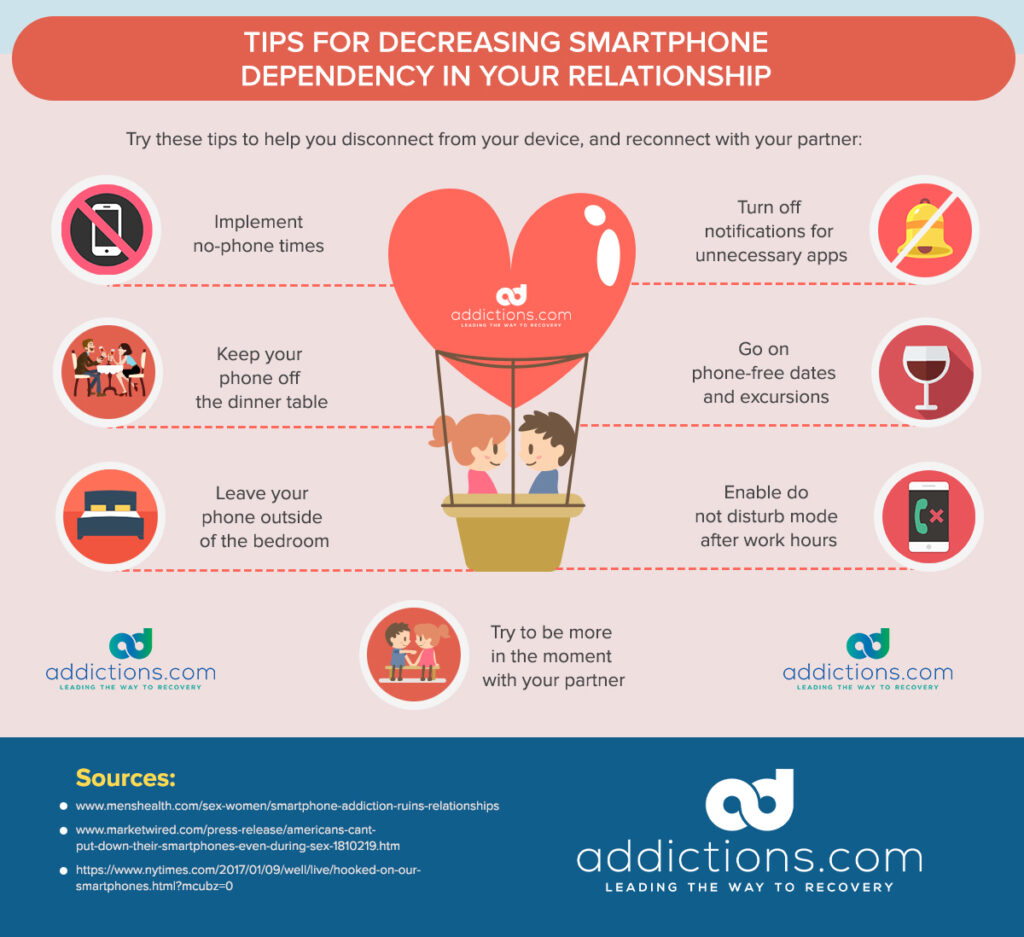
1. Minimize unnecessary smartphone usage
Try to figure out how much of your smartphone use is necessary—for work, for communicating with loved ones, for keeping up with caregiving duties, or for using apps to help with driving or checking movie times—and how much of it is unnecessary habit, like checking Facebook or reposting on Tumblr. Remember that in the early days of your recovery from smartphone addiction, all smartphone habits will FEEL necessary to you emotionally. This attachment will improve over time.
2. Allocate data-free time during the day
Designate a certain amount of data-free time every day. Silence your phone (no fair using vibrate), or turn it all the way off, between certain hours of the day at work or school, or whenever you’re working out or on a date. Putting it somewhere out of sight will help put it out of your mind—or at least cut down on how distracted you’ll be from the activity at hand.
3. Silence your phone when driving
Smartphone addicts should especially silence their phones while driving. The distraction of hearing a notification or the temptation to check email could have dangerous, even deadly consequences.
4. Find other interests for your free time
Develop new interests or hobbies to fill up the time you used to spend on your device.
5. Use an old-fashioned alarm clock
Avoid using your phone as an alarm—it’s too easy to shift from turning it off to checking email and browsing Instagram.
6. Remove excess apps
You’re much better off deleting apps that connect you to Twitter, Facebook, Tumblr, and other social media distractions from your phone. Having to set aside time to go to your computer to participate instead of being constantly connected to it 24/7 will free up your time, and prove that you aren’t missing out on as much as you fear you are.
7. Minimize app notifications
If you can’t bring yourself to ditch the apps yet, at least turn off the notifications, and if you can’t bring yourself to turn them all off, at least limit notifications to the most important apps, like the one connected to your child’s school. Today, you can also find apps specifically designed to block your access to other, more distracting apps during peak times of productivity, so you can focus better.
You also might want to consider setting special ringtones or vibrations for the most important people in your life, so you can know if it’s your best friend calling about your dinner plans without having to check, which may tempt you into other activities on your phone.
8. Stop checking your email before work
If there is an emergency, you will get a phone call. Otherwise, any message sent by email can safely wait for another hour or two. Also, consider shutting off your email entirely over the weekend. People might send you work emails on Saturday or Sunday, but you are not obligated to respond to them. In most cases, the sender doesn’t even expect you to—they were simply checking something off their to-do list when they had the time to do it.
9. Leave your phone out of the bedroom
This last strategy will not only help you sleep better by reducing distractions and eliminating the screen light that can contribute to insomnia, but it will also improve intimacy with your partner, even on nights when you don’t have sex.
Smartphone addiction doesn’t have to get in the way of a healthy, fulfilling relationship. By following the tips above, you can reclaim your connection with your partner and discover new and exciting ways to bond that don’t involve a screen. If you or someone you love is struggling with smartphone addiction and needs professional treatment to overcome it, rehab programs are avaiable. source