

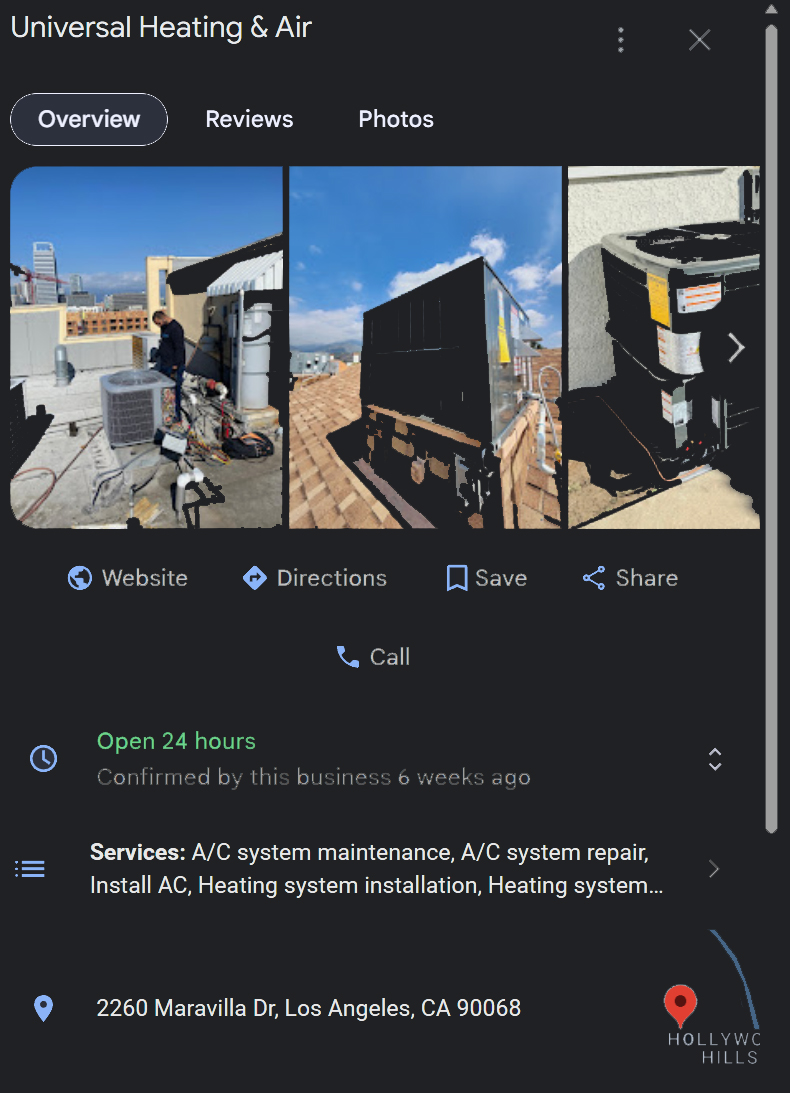
$1,736 Up in Vapor: Our Air Conditioner Died 24 Hours After “Universal Heating & Air” Charged Us for a Leak Repair — Then They Tried to Sell Us a New Unit
A quoted price that grew $58.71 after the click. An invoice “due” the day before it was sent. Two different company names on the same license. And eight pounds of refrigerant pumped into a system that couldn’t hold it. Here is the paper trail.
OUR OPINION IS STAY FAR AWAY FROM United Heating & Air 2260 Maravilla Dr Los Angeles CA 90068
By Good Shepherd Media Staff | West Hollywood, California
EDITOR’S DISCLOSURE: This is a first-party consumer account. The transaction described below was paid for by this publication’s own household, and every claim in this article is drawn from documents in our possession — the company’s own invoice, its own text messages, and its own client portal — reproduced and quoted with precision. Characterizations of the company’s motives are the opinion of this publication, formed from the documented facts stated herein. We invite Universal Heating & Air to respond in writing; any response will be published in full.
The Job: Paid in Full, Failed in Full — in Under a Day
On Wednesday, July 29, 2026, Universal Heating & Air — operating from 2260 Maravilla Dr, Los Angeles, phone (323) 763-5777, advertising California contractor license #1069748 — was paid $1,736.21 for a service call in West Hollywood. Their own invoice (#3724) itemizes the work:
- “Leak repair 1 — Find a leak and repair over the valve for the compress[or]” — $300.00
- “Freon R-410A Per Paund” [their spelling, not ours] — 8 pounds at $125.00/lb — $1,000.00
- “System check and run 1” — $175.00
- “Maintenance” — $125.00
Read that list again. They billed for finding a leak. They billed for repairing a leak. They billed for checking the system. They billed for maintenance. And then they billed one thousand dollars to pump eight pounds of R-410A refrigerant into the system they had just certified, by their own line items, as found, fixed, checked, and maintained.
Within twenty-four hours, the system was stone dead. All eight pounds of refrigerant — the entire $1,000 charge — had escaped. The technicians returned and announced there was, in their words, a “huge hole in the coil.”
And then came the part every homeowner in Los Angeles should memorize: they immediately tried to sell us a brand-new air conditioner.
Why This Cannot Be Explained as an Honest Mistake
Here is the industry standard, and it is not obscure. A legitimate leak repair on a refrigeration system includes a leak search and a verification test before refrigerant goes back in. Federal EPA regulations governing refrigerant work (40 C.F.R. § 82.157) require that a repair verification test “be performed after the conclusion of the repair work and before any additional refrigerant is added to the appliance.” Standard trade practice is to pressurize the system — typically with dry nitrogen — and hold pressure to confirm it is tight. A standing pressure test held for even twenty minutes exposes a significant leak every single time.
A hole in a coil large enough to dump eight pounds of refrigerant in under a day is not a pinhole. It is not subtle. It is the kind of gross, catastrophic defect that no competent pressure test — indeed, no competent technician paying attention to his own gauges — could possibly miss.
Which leaves exactly two possibilities, and the reader may choose whichever is more charitable:
- The leak search, leak repair, system check, and pressure verification that were billed and paid for were never actually performed — meaning the customer paid $600 in labor line items for work that did not happen; or
- The work was performed, the catastrophic leak was detectable, and the company pumped $1,000 of refrigerant into a system it knew or should have known could not hold it — refrigerant that was always going to vent into the atmosphere within hours — perfectly teeing up the next morning’s sales pitch for a replacement unit.
In this publication’s opinion, that second scenario has a name in the HVAC trade: it is the classic refrigerant-dumping upsell. Charge big money to gas up a dying system, let physics do its work overnight, then return in the morning wearing a sad face and carrying a quote for a new condenser. The refrigerant charge isn’t a repair — it’s bait for the real sale.
The $58.71 That Appeared After the Click
The failed repair is only half the story. Examine how this company quotes a price — because we kept the receipts, the texts, and the screenshots.
On Wednesday afternoon, Universal Heating & Air sent a text message stating, verbatim: “Your invoice total is $1,677.50, and needs to be paid by Tue Jul 28, 2026.” That figure is precise: it is the $1,600.00 subtotal plus $77.50 in tax. That was the total. That was the representation.
Click the payment link in that same text, however, and the invoice waiting at the other end demands $1,736.21. Between the quoted total and the charged total, a $58.71 “Service Fee” materialized out of thin air — a fee mentioned nowhere in the quote, agreed to by no one, and tacked on at the moment of payment. Quote one number, charge a higher one, and pocket the difference: whatever the company wishes to call that line item, the practice of quoting $1,677.50 and collecting $1,736.21 speaks for itself.
An Invoice Due Before It Existed, and a Company With Two Names
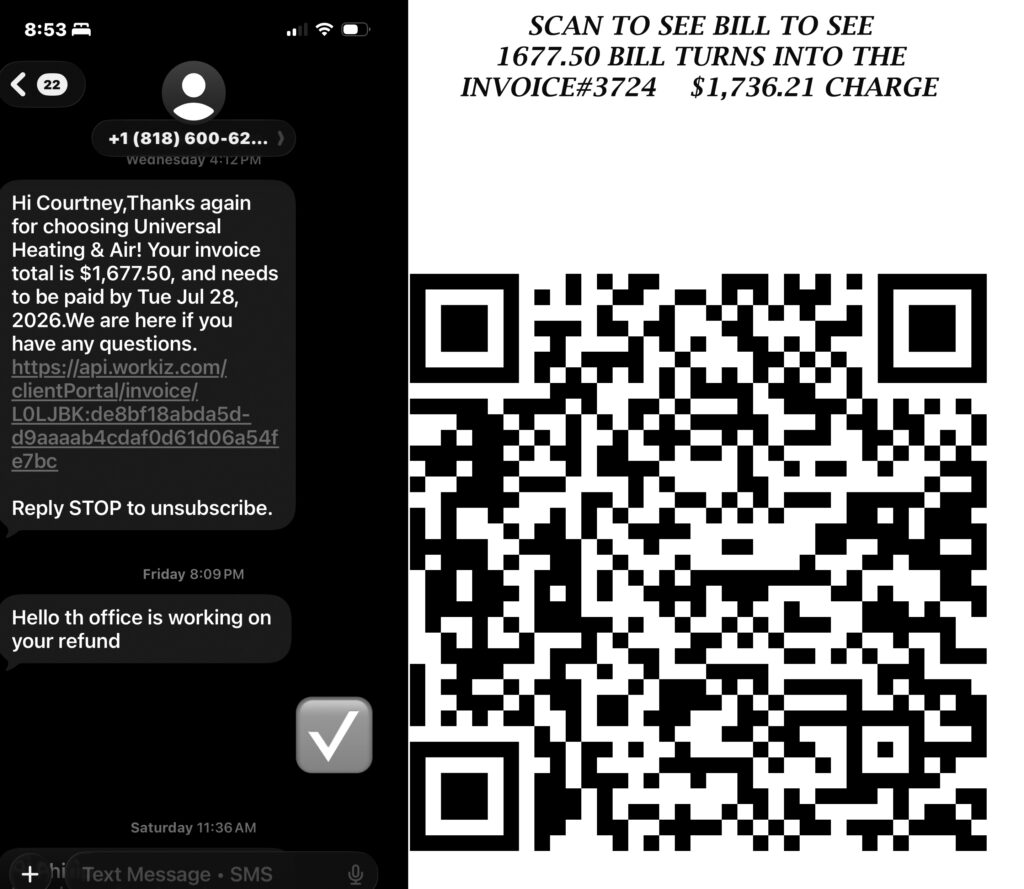
The sloppiness — or something worse — does not end there. The company’s own client portal shows Invoice #3724 was sent July 29, 2026, with a due date of July 28, 2026. The bill was past due the moment it was born. Manufactured urgency, or mere incompetence? Either answer should worry you.
Stranger still: the text messages, the branding, and the receipt all say “Universal Heating & Air.” The formal invoice on the payment portal is issued in the name of “United Heating & Air” — a different company name — at the same address, the same phone number, and the same license number, #1069748. Consumers are entitled to know exactly which legal entity is taking their money and standing behind the work. Here, the company’s own paperwork can’t keep its story straight.
“Th Office Is Working on Your Refund”
On Friday evening, after the failure and the complaint, the company texted: “Hello th office is working on your refund.” We preserve that message here for two reasons. First, it is a written acknowledgment, from the company itself, that a refund is owed. Second, as of publication, no refund has been received. This article will be updated the day that changes — and every week that it doesn’t.
The Review Record: Read Past the Stars
Prospective customers who search this company on Google will find a wall of glowing reviews. Prospective customers who search the same company on Yelp will find a 1.0-star rating. That is not a difference of opinion; that is a chasm. We encourage every reader to look at both platforms side by side, note the disparity, and draw their own conclusions about which body of reviews reflects the experience described — and documented — in this article.
The Bottom Line for Santa Clarita and Los Angeles Homeowners
Our documented experience with Universal Heating & Air: a $1,736.21 charge; a “leak repair” that did not survive a single day; $1,000 of refrigerant vented into the sky; a same-week sales pitch for a new unit; a price that grew $58.71 between the quote and the click; an invoice due before it was sent; two company names on one license; and a promised refund that has not arrived.
In this publication’s opinion, no homeowner should let this company near their equipment or their credit card until every question raised by its own paperwork is answered. If you hire any HVAC contractor for a leak repair, demand — in writing, before payment — the leak location found, the repair method used, and the standing pressure test results. A contractor who performed the work will hand them over proudly. A contractor who didn’t will get very quiet.
PROTECT YOURSELF: Verify any California contractor’s license, classification, and complaint history free at cslb.ca.gov. HVAC refrigerant work requires a C-20 classification and EPA Section 608-certified technicians. If you believe you’ve been defrauded by a contractor, you may file a complaint with the Contractors State License Board, the Los Angeles County Department of Consumer & Business Affairs, and your card issuer.
HAVE YOU HAD A SIMILAR EXPERIENCE with this company? Good Shepherd Media wants to hear from you, with documentation. All sources kept confidential upon request.
Good Shepherd Media stands behind every factual statement in this article, each of which is supported by documents in our possession, including Invoice #3724, the company’s SMS communications, and screenshots of the company’s client payment portal. Statements of opinion are identified as such and reflect this publication’s honest assessment of the documented facts. Universal Heating & Air (a/k/a United Heating & Air), and any principal thereof, is invited to submit a written response for unedited publication: contact Good Shepherd Media.