

Investigation · Government Accountability
The City Put It in Writing: It Had No Consent. Six Days Later, Its Inspectors Were Inside the Building.
West Hollywood recorded a property owner’s request as a “denial” of entry — words he never said — then went silent, entered his building through an arrangement with a tenant, and told no one. The owner learned of it 27 days later, from a letter written by the City’s outside counsel.
By M. Reynolds · Good Shepherd Media
West Hollywood, Calif.
In our earlier reporting, West Hollywood’s answer to a documented water-intrusion complaint was to schedule an inspection of the complainant’s building while leaving the source next door unopened. What the City did next, its own correspondence now shows, went further: it entered the complainant’s building anyway — after putting in writing that it understood it had no consent from the owner to do so.
A “Denial” the Owner Never Made
In late August, the owner — referred to here as Mr. Zullo — responded to the City’s scheduling emails with a voice message. According to the owner, and consistent with the written record around it, the message did not refuse an inspection. It set an order of operations: inspect the offending property next door first — the one his written demand had identified as the source — then contact him that same day to meet and inspect his building together.
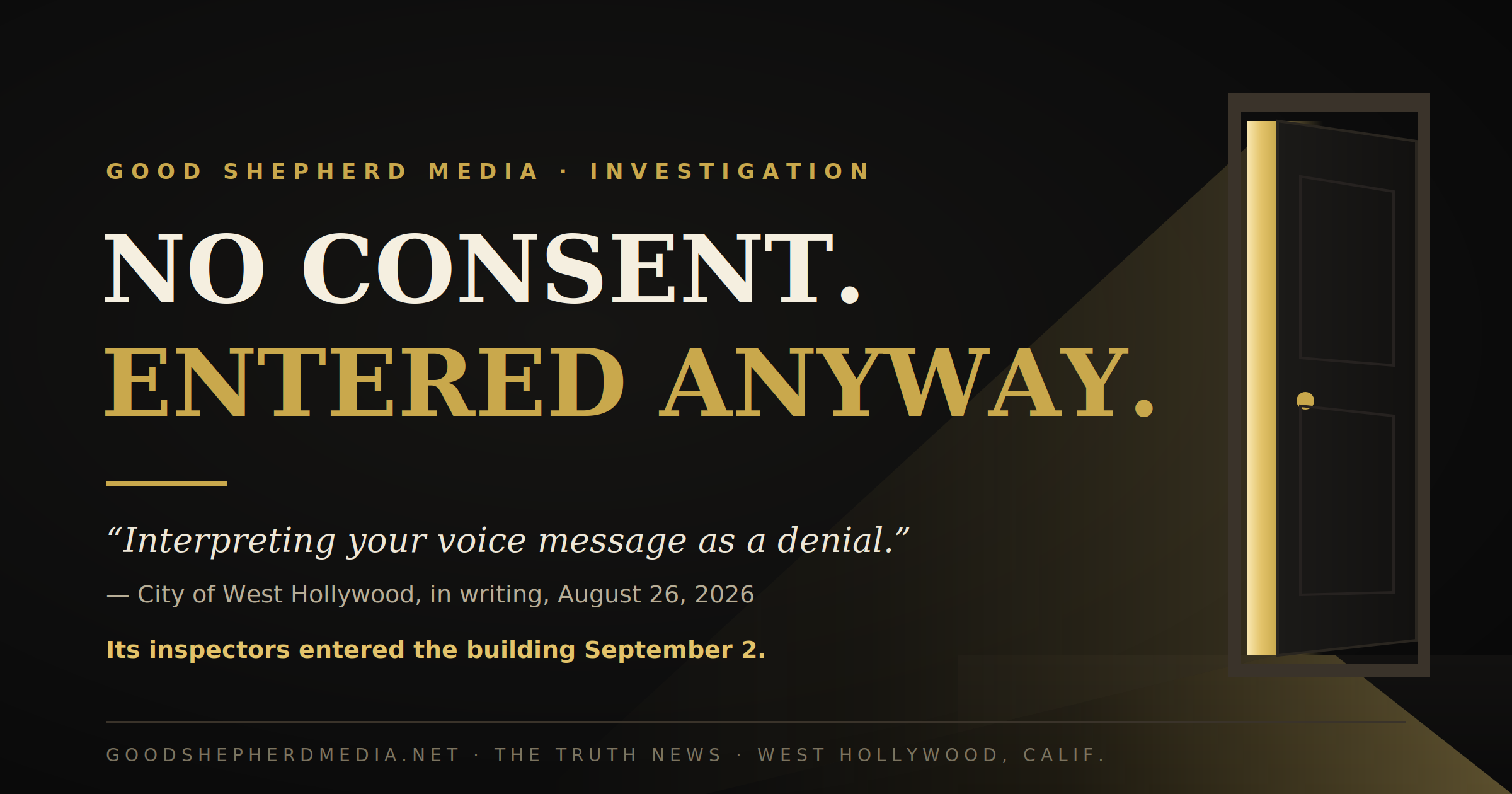
Assistant City Manager Steve Campbell’s written reply, on August 26, recorded something else entirely. He wrote that he was “interpreting [the] voice message as a denial” of access, and that the City “will render findings absent such inspection.” A sequencing request became, in the City’s file, a refusal.
Whatever one makes of that characterization, note what it establishes: as of August 26, 2026, the City’s own position, in its own writing, was that it did not have the owner’s consent to enter 7513 Santa Monica Boulevard.
Then Silence — Then an Entry Nobody Mentioned
After August 26, the record reviewed by this newspaper shows no further communication from the City to the owner about entering his property. No corrected understanding. No new proposed date. No answer to the owner’s offer to meet the same day the source was inspected. Having been told — wrongly, he says — that he had “denied” entry, and hearing nothing further, the owner had no reason to expect City staff to appear at his building at all.
They appeared anyway. According to the September 29, 2026 letter from the City’s outside counsel, City staff entered and inspected 7513 Santa Monica Boulevard on September 2, 2026 — by arrangement with a tenant. Not with the owner. Not with notice to the owner. The owner of record learned his building had been entered 27 days after the fact, from the City’s lawyer. The City’s September 4 and September 18 records-production letters, sent after the entry, had not mentioned it.
On August 26 the City wrote that it had no consent. On September 2 it was inside the building. In between, it said nothing to the man who owns it.
What a Tenant Can — and Cannot — Open the Door To
A tenant’s consent is real, but it is bounded: it reaches the premises that tenant leases and controls. It does not reach the building’s owner-controlled portions — common areas, exterior and shared walls, the roof, utility areas — which is precisely where a water-intrusion inspection looks. The building at 7513 also includes an attached residential dwelling, where the law of entry is at its strictest. The U.S. Supreme Court held nearly sixty years ago that even routine administrative code inspections are searches, and absent consent they require a warrant (Camara v. Municipal Court (1967) 387 U.S. 523). California gives agencies the tool for exactly this situation: an inspection warrant under Code of Civil Procedure sections 1822.50–1822.57. The City did not seek one.
The owner has now lodged a formal objection with the City, contending the September 2 entry was a trespass and an unconstitutional warrantless search — consent-less under the City’s own August 26 account — in violation of his Fourth and Fourteenth Amendment rights, and he has formally revoked consent to any future entry outside a tenant’s own leasehold absent his written consent, an inspection warrant, or a genuine emergency. Those are the owner’s contentions, now in the City’s hands in writing; a separate complaint is before the City Manager. What is not contention but documented fact is the sequence: a written “no consent” on August 26, an entry on September 2, and an owner told nothing until September 29.
The Dry-Season Finding That Answers Nothing
And what did the City bring back from the building it entered without the owner? Its counsel’s letter reports that inspections on August 13 and September 2 found “no evidence of a water leak.”
Good Shepherd Media has reviewed the owner’s correspondence with the City. In none of it does he claim a permanent, always-on leak. From his first written demand, the complaint has been the same: rainwater intrusion during rain events, recurring every rainy season since the neighbor’s City-permitted remodel — multiple documented events across multiple years, supported by video of running water previously sent to the City, and by the City’s own 2017 inspection photograph showing water staining inside the bar next door, on the far side of the very wall at issue. Checking that wall for an “active leak” in mid-August and early September — the driest weeks of the Los Angeles calendar — and reporting none is not a finding. It is an answer to a complaint no one made. The owner’s standing request — a joint inspection during or immediately after the first rain, when the condition demonstrates itself — remains open and unaccepted. And that is the ledger to keep in view: the problem is still open, the wall is still unabated, the rainy season is coming — and the file of demands, notices, productions, and lawyers’ letters that now surrounds it was generated not by the complaint, which has never changed, but by the City’s answers to it.
The City’s Position
The City’s September 29, 2026 letter, from its outside counsel, states that staff inspected both properties in August and September, found no evidence of an active water leak, and that a tenant arranged the September 2 access to 7513. The letter does not state that the owner was notified of the entry before or after it occurred, does not identify who entered or what was inspected or photographed, and the records of both inspections had not, as of this writing, been produced in response to the pending public-records requests that squarely cover them. Good Shepherd Media previously invited the City’s comment on this matter in writing on August 27, 2026, with a response deadline of September 5, 2026. No response of any kind was received — not by the deadline, and not since. Ahead of this report, Good Shepherd Media has again invited comment from the City, Mayor John Heilman, Assistant City Manager Steve Campbell, City Manager Jackie Rocco, and the City’s outside counsel, and will update this report with any substantive response.
Five Questions West Hollywood Must Answer
1. On August 26 the City recorded, in writing, that it lacked the owner’s consent to enter 7513. On what legal authority did its staff enter that building on September 2 — without the owner’s knowledge, without a warrant, and without ever contacting him again?
2. Who entered, which parts of the building did they enter or photograph, and did any of it extend beyond the consenting tenant’s own leased premises — or into the attached dwelling?
3. Why was the owner told nothing for 27 days — and then only in a letter from outside counsel?
4. Why does the City characterize a dry-season “no active leak” check as responsive to a complaint that has always, in writing, described rain-event intrusion recurring every rainy season since the remodel next door?
5. Will the City accept the owner’s standing offer of a joint inspection at the first rain event — and produce the complete records of the August 13 and September 2 inspections, which remain unproduced under the pending Public Records Act requests?
6. Finally, for completeness: our reporting notes that a Government Claims Act claim concerning the water intrusion is on file with the City Clerk, and that under California law an unabated continuing condition exposes a public entity to inverse condemnation and continuing-nuisance liability that renews with each rain event (Baker v. Burbank-Glendale-Pasadena Airport Authority (1985) 39 Cal.3d 862) — liability no immunity statute reaches (Nestle v. City of Santa Monica (1972) 6 Cal.3d 920; Pacific Bell v. City of San Diego (2000) 81 Cal.App.4th 596).
 |
M. Reynolds
Investigative Reporter, Good Shepherd Media
|
This report is based on the parties’ written correspondence, including the City’s letters of August 20, August 21, August 26, September 18, September 28, and September 29, 2026, the owner’s demands of July 21, August 11, October 1, and October 3, 2026, and records produced by the City under the California Public