

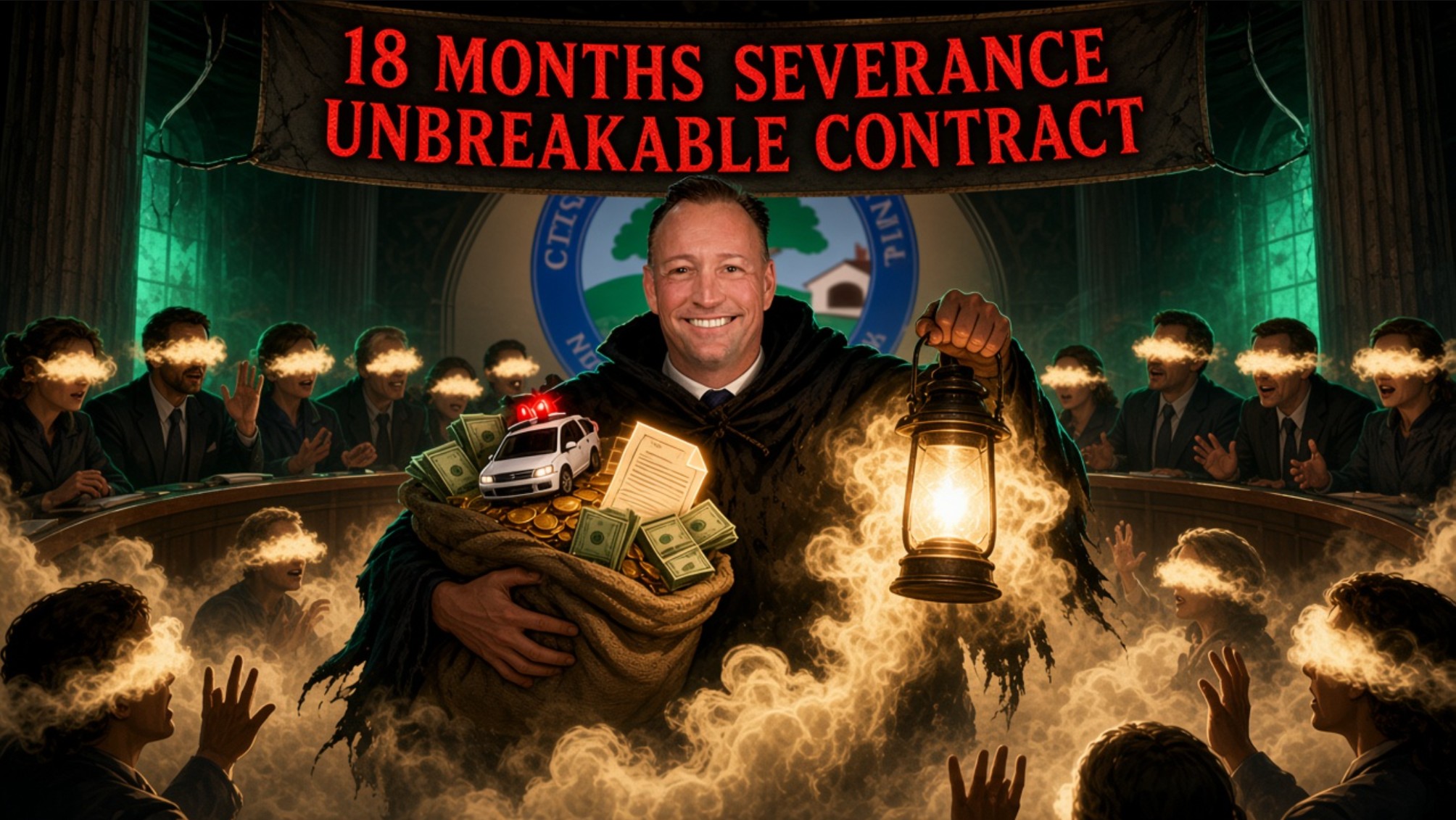
$487,298 a Year, a City Car, 18 Months of Severance, and a Contract Four Councilmembers Can’t Break. What Does Santa Clarita Get From Ken Striplin?
The City Manager’s own Building Official told him in writing on September 1 that commercial events on residential land are not allowed. On September 16 he told the press staff were “working with the property owners.” On October 18 a 200-guest wedding went ahead. Here is what the public is paying for that, who decided it, and what the contract says.
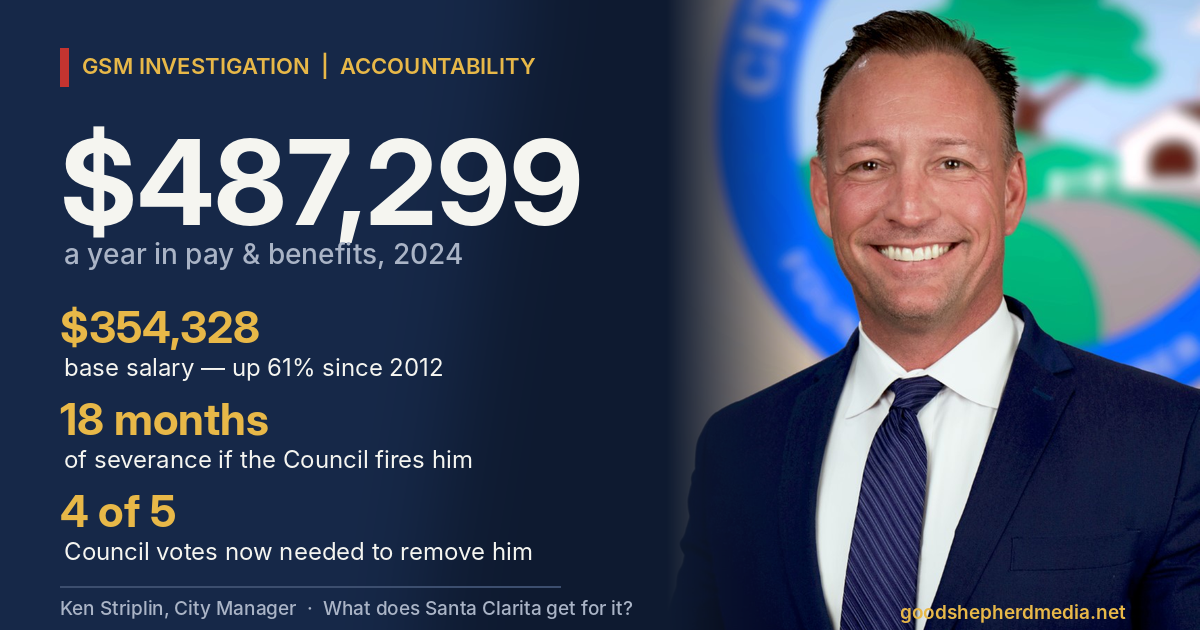
Kenneth W. Striplin has run the City of Santa Clarita since December 1, 2012. He is not elected. No resident has ever cast a vote for him, and under the City’s council-manager form of government no resident ever will. He is hired, paid, evaluated and, in theory, fired by the five members of the City Council. In 2024, according to payroll data the City reports to the State Controller and published by Transparent California, he was paid $383,682.54, and the cost to taxpayers including benefits was $487,298.97. That is more than the Governor of California is paid to run a state of 39 million people.
Good Shepherd Media has spent eight weeks asking Dr. Striplin’s office to enforce the City’s own zoning code against three commercial wedding venues operating on residential land in Sand Canyon. This article is about what that money buys, who decides the number, and what the record shows the City Manager did with the information his own staff gave him.
What the contract says
The City Manager’s employment agreement is a public record, posted on the City’s own Human Resources page. It was signed September 11, 2012 and has been amended three times. Good Shepherd Media read all four documents. This is what they provide:
| Starting salary (Sec. 3) | $220,000 per year, effective December 1, 2012. Guaranteed increases of “not less than 5%” in 2014 and 2016 if the Council found he “met performance expectations.” “Additional merit increases may be provided… at the City Council’s discretion.” |
| Salary today | $354,328 base (2024). That is a 61% increase. None of the three posted amendments changes the salary. The raises that took him from $220,000 to $354,328 were granted some other way, and the City has not posted where. |
| Deferred compensation (Sec. 4) | City deposits the maximum amount permitted by the IRS into a deferred-compensation account for him every month, on top of salary, adjusting automatically whenever the IRS limit rises. |
| Pension (Sec. 5) | CalPERS, with the City paying its share. Transparent California lists an additional $18,278 in 2024 toward the City’s unfunded pension liability attributable to him. |
| Automobile (Sec. 10) | “Exclusive and unrestricted use at all times” of a City-provided car, with the City paying insurance, maintenance, repair and replacement. |
| Life insurance (Sec. 8) | Up to $2,400 a year for a policy of his choice, plus term life equal to twice his annual salary. |
| Health & wellness (Secs. 6, 9) | Full health, dental and vision; a comprehensive physical every two years including a treadmill cardiac evaluation; $1,000 a year for “health benefit activities and equipment.” |
| Leave (Secs. 12, 13) | 30 vacation days a year (raised from 20 by the 2019 amendment), 15 administrative-leave days, 12 sick days, plus City holidays. Unused vacation above three years’ accrual is paid out in cash. |
| Dues, conferences, travel (Sec. 11) | City pays professional dues, subscriptions, conference fees, travel and subsistence, and up to $1,000 a year for “local service organizations.” |
| Severance (Sec. 14) | If the Council fires him: 12 months of salary and health benefits, plus one month for every year of service, up to 18 months. He passed 18 months of eligibility years ago. At today’s base, that is roughly $531,000 plus benefits to let him go. |
| Election protection (Sec. 15) | Fire him within 90 days of a Council election and the City owes an additional 90 days of severance on top of the 18 months. |
| Removal (Third Amendment, Jan. 11, 2022) | The Municipal Code’s ordinary removal process was replaced: the City Manager can now be removed “only by a 4/5 vote of the whole Council.” Two councilmembers can keep him in office indefinitely, against the wishes of the other three. |
| Performance review (Sec. 16) | The Council and the City Manager are to set written annual goals and “a relative priority among those various goals,” and the Council is to evaluate him against them at least once a year. |
Read those last two rows together. The five people who could hold him accountable are the five people who agreed, in 2022, that four of them would have to vote together to do it. Councilmembers Weste, McLean, Miranda and Gibbs were on the dais when that amendment was approved. Councilmembers earn $32,269.92 a year for the job; the man they supervise earns eleven times that in base salary alone.

Who decides the number
The answer is: the same five people, mostly in closed session. California’s Brown Act lets a council evaluate its City Manager behind closed doors under Government Code section 54957. But it does not let them set his pay there. Section 54957(b)(4) prohibits taking action on compensation in closed session, and section 54953(c)(3) requires that before any final action on an executive’s salary or benefits, the Council “orally report a summary of a recommendation for a final action on the salaries, salary schedules, or compensation paid in the form of fringe benefits” in open session. Every raise from $220,000 to $354,328 should therefore appear in a public agenda, a public oral summary and a public vote.
Good Shepherd Media has asked the City Clerk for every one of those records: each salary adjustment since 2012, the agenda item and minutes approving it, the section 54953(c)(3) oral summaries, the written annual goals the contract requires, and the criteria the Council used. The contract says those goals are to be “reduced to writing.” If they exist, they are public records. If they do not exist, the Council has been granting raises without the evaluation its own contract requires.
What the public got for it in Sand Canyon
On August 25, Good Shepherd Media sent a formal complaint to the City Manager and every member of the City Council: two properties in Sand Canyon operating as commercial wedding venues with bars, on parcels zoned Non-Urban 4, where that use is prohibited. The City’s internal email chain, released under the Public Records Act, shows what happened next.
| Aug. 26, 4:23 p.m. | City Clerk forwards the complaint to the City Manager’s office, copying Dr. Striplin. |
| Aug. 26, 4:26 p.m. | Masis Hagobian, Interim Assistant to the City Manager: “I’m going to review and also send to Daniel to send a code officer to follow-up.” |
| Aug. 26, 4:54 p.m. | Patrick Leclair, Planning Manager: “Nothing rings a bell on these.” |
| Sept. 1, 5:12 p.m. | Dr. Striplin to Good Shepherd Media: Community Preservation “will follow up as appropriate”; if violations are found a code officer “will notify the property owners and work with them.” Planning “did not identify a Conditional Use Permit for either property.” He directs the reporter to look up business and liquor licenses herself. |
| Sept. 1, 6:11 p.m. | John Caprarelli, P.E., City Building Official, to the Director of Community Development: “The complaints appear to be related to events and alcohol sales. The Building Code does not allow private property to be used for public (commercial) events unless it meets commercial requirements (assembly occupant load, egress, access, sanitary facilities, etc.)” |
| Sept. 16 | Dr. Striplin to Good Shepherd Media: the City has “an active code enforcement case” and staff are “actively working with the property owners to address the outstanding issues and bring the properties into compliance.” No further details will be provided. |
| Sept. 20 & Oct. 18 | Good Shepherd Media submits written press questions with deadlines of October 2 and October 20. The October 2 deadline passed without answer. |
| Oct. 5 | City Clerk confirms three open zoning cases: CE-26-1754, CE-26-1755, CE-26-1844. Case files withheld. |
| Oct. 18 | A wedding of an estimated 200 guests is held at the Triumph Avenue venue. Hundreds of cars on a vacant lot. Sheriff’s complaint SCT 26291-0156. Video is public. |
The City Manager had his own Building Official’s written opinion that the use is not allowed on September 1. He had it for fifteen days before he told the press the City was “working with the property owners.” He had it for forty-seven days before the October 18 wedding. In that time, the City produced no Notice of Violation, no citation and no inspection record for the Triumph Avenue property in response to a records request that asked for all of them. The venue, meanwhile, marked itself “closed” on Yelp, wiped its website, and kept its booking platforms live.
“Working with the property owners” is the phrase a $487,000-a-year administrator uses when he has decided not to enforce the law and does not want to say so.
The questions Dr. Striplin has not answered
Good Shepherd Media has put the following to the City Manager in writing. None has been answered.
- What does “working with the property owners” consist of, and does it include permitting events to continue while a case is open?
- Why was no Notice of Violation issued in the 47 days between the Building Official’s September 1 email and the October 18 wedding?
- Did any City employee communicate to any operator the existence, timing or source of a complaint?
- Why does the City cite residents for sheds and fence heights in the same canyon while three commercial operators go uncited?
- On what dates, by what votes, and against what written goals was his salary raised from $220,000 to $354,328?
He has until the end of Friday, October 23, to answer the first four. The fifth is a Public Records Act request; the City has ten days.
What residents can do
The City Manager’s contract is not a secret and his pay is not a mystery. Both were set by Mayor Laurene Weste, Mayor Pro Tem Patsy Ayala, and Councilmembers Marsha McLean, Jason Gibbs and Bill Miranda, and by their predecessors. Councilmembers McLean and Miranda are leaving the dais in December; three seats are on the November ballot. Every candidate for those seats can be asked one question: will you vote to restore majority-vote removal of the City Manager, and will you condition his next raise on written, public performance goals that include code enforcement in Sand Canyon?
Residents may also address the Council directly at any regular meeting, second and fourth Tuesdays at 6:00 p.m., under Public Participation, three minutes per speaker. The City Manager sits at the dais for all of it.

Sources:
