

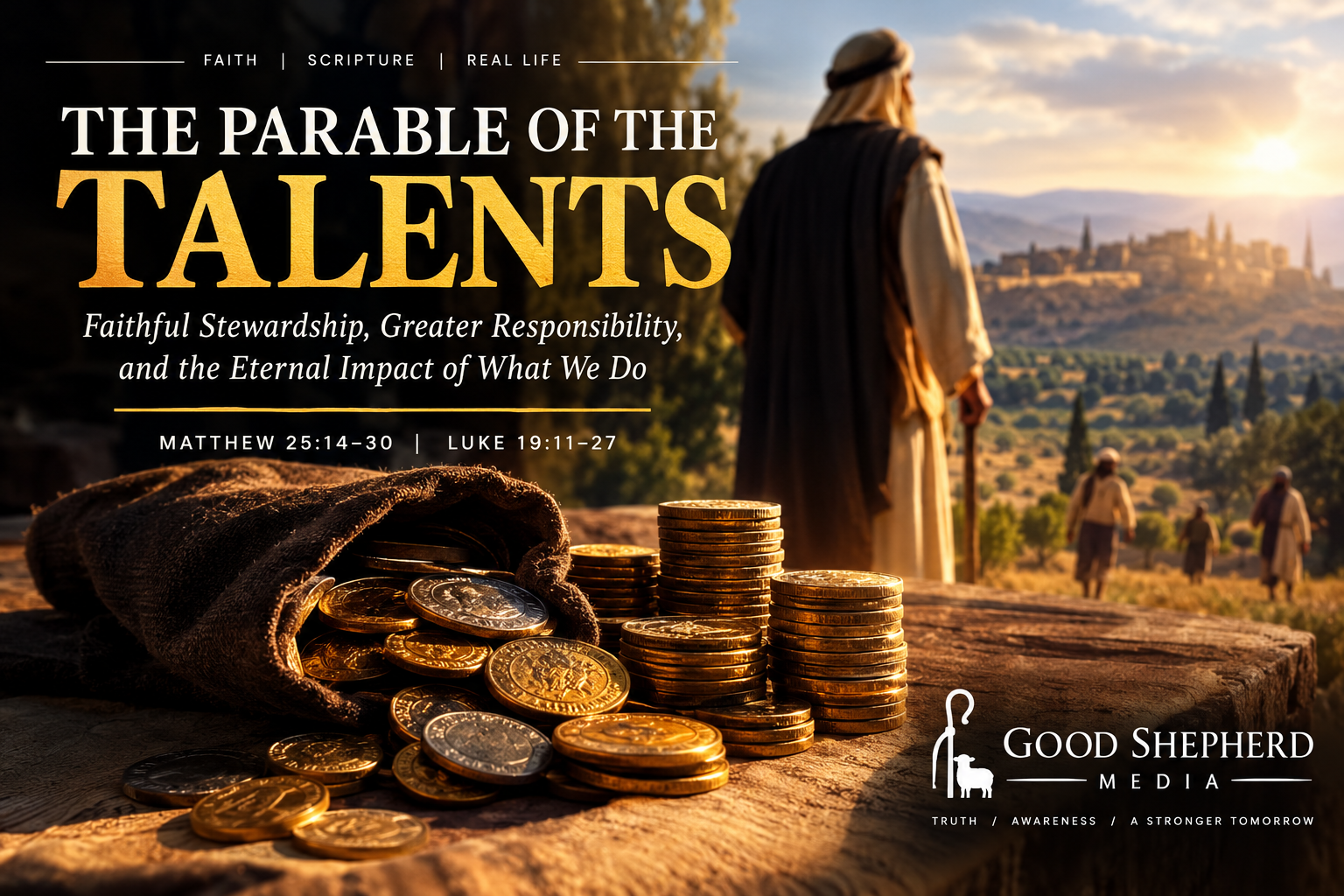
The Parable of the Talents: Faithful Stewardship, Greater Responsibility, and the Eternal Impact of What We Do
By Good Shepherd Media | Faith, Scripture & Real Life
Primary Scripture: Matthew 25:14–30
Related Scripture: Luke 19:11–27
Introduction: What Are You Doing With What God Has Given You?
One of the most challenging teachings of Jesus Christ concerns a question every person should eventually ask: What am I doing with what I have been given?
In Matthew 25:14–30, Jesus tells the story of a master who entrusts his possessions to three servants before departing on a journey. To one servant, he gives five talents; to another, two; and to the third, one. Each receives a different amount, and each must decide what to do with the responsibility entrusted to him.
Two servants put their master’s money to work and increase what they have received. The third servant, however, becomes fearful. Rather than investing the money or seeking a productive way to use it, he buries it in the ground.
When the master returns, he rewards the servants who acted faithfully and confronts the servant who did nothing with what he had been given.
At first glance, this may seem like a lesson about money, investment, or business. But Jesus is teaching something far more profound: the importance of faithfulness, personal responsibility, courage, accountability, and readiness for the Kingdom of Heaven.
The parable challenges us to examine how we use our time, abilities, opportunities, resources, influence, and knowledge. It also confronts a dangerous temptation: believing that avoiding mistakes is the same as doing what is right.
God’s question is not simply what we possess, but how faithfully we use what has been entrusted to us.
1. Understanding the Historical Meaning of a Talent
Before examining the parable, it is important to understand what Jesus meant by a talent.
In the biblical world, a talent was a substantial unit of weight used to measure precious metals and, by extension, a significant amount of money. It was not originally a word meaning a person’s natural ability, musical gift, or professional skill. The modern English meaning of talent as an aptitude developed in part through the influence of this parable.
A talent represented considerable wealth. The precise modern equivalent depends on the metal, valuation method, and historical assumptions used, so assigning it a single present-day dollar value can be misleading.
Nevertheless, the scale of the master’s entrustment is clear. He was not handing his servants insignificant sums. He was placing substantial resources under their care.
Matthew 25:15 explains that the master distributed his wealth according to each servant’s ability. One received five talents, another two, and another one.
This detail matters.
The master did not give everyone an identical assignment. He entrusted different amounts according to their respective capacities.
The lesson is not that every person receives the same resources, opportunities, intelligence, physical strength, financial circumstances, or responsibilities. Human lives are different. People begin from different places, encounter different obstacles, and possess different gifts.
But the parable teaches that each person remains responsible for what has actually been entrusted to them.
A person with modest resources should not despise what they possess simply because someone else has more. Likewise, a person entrusted with considerable resources should not assume that wealth itself proves righteousness or divine approval.
The issue is faithfulness.
2. The Master Departs: A Period of Trust and Responsibility
Jesus begins the story by describing a man preparing to travel to a distant country. Before leaving, the man calls his servants and entrusts his possessions to them.
The master does not remain beside them every day, directing every decision. He gives them responsibility and leaves them to act.
This establishes one of the central themes of the parable: stewardship.
A steward is someone entrusted with property, resources, or responsibilities that ultimately belong to someone else. A faithful steward does not regard the master’s possessions as an excuse for selfishness. Instead, the steward recognizes the obligation to manage them wisely.
The biblical principle extends well beyond financial affairs.
Consider the many things people may be entrusted with:
- Time: Every day presents opportunities to help others, learn, work, pray, and do what is right.
- Knowledge: Understanding creates opportunities to teach, warn, protect, and serve.
- Abilities: Skills can be used to build, repair, create, encourage, and solve problems.
- Financial resources: Money can support families, provide necessities, fund worthwhile work, and assist people in need.
- Influence: A person’s words and reputation can encourage others toward truth or lead them toward error.
- Positions of responsibility: Parents, business owners, public servants, teachers, and community leaders all make decisions that affect other people.
None of these responsibilities is automatically virtuous. Knowledge can be used to deceive, money can be used to exploit, and influence can be used to manipulate.
The moral question is how these things are used.
The parable asks readers to consider whether they are treating their opportunities as responsibilities or wasting them through indifference, selfishness, or fear.
3. The First Two Servants: Faithfulness Through Action
Matthew 25:16–17 describes the first two servants responding to their assignments.
The servant who received five talents puts them to work and gains five more. The servant who received two does the same and gains two more.
Both act.
Both accept responsibility.
Both produce a return from what they have received.
Yet their achievements differ in size. One gains five talents, while the other gains two. Jesus does not condemn the second servant for producing a smaller total. Instead, both ultimately receive the same words of commendation from their master.
In Matthew 25:21 and 25:23, the master tells each faithful servant, in substance, that he has done well, has been faithful over a few things, and will be entrusted with greater responsibility. Both are invited to share in their master’s joy.
This is one of the most encouraging elements of the entire parable.
The master’s praise is based on faithfulness, not on the servants having identical starting points or identical totals.
The servant who began with two talents was not expected to produce the same absolute return as the servant who began with five. Each was responsible for the assignment received.
This principle challenges the habit of measuring our lives exclusively against other people.
Someone else may possess more money, greater intelligence, better connections, superior physical abilities, or opportunities we never received. Comparing ourselves endlessly with those people can distract us from our own responsibilities.
The second servant did not bury his two talents because another servant had received five. He acted with what was available to him.
Imagine a person who has little money but consistently helps a struggling neighbor. Consider someone who possesses technical knowledge and uses it to protect vulnerable people from fraud. Think of a business owner who treats employees honestly, a parent who raises children with patience, or a journalist who pursues truth despite pressure to remain silent.
These examples illustrate how responsibility can be exercised in very different circumstances.
The point is not that every undertaking will produce financial success or visible results. Nor does the parable promise that every faithful action will be rewarded with worldly prosperity.
Rather, it teaches that what we have been given should not be wasted merely because our circumstances are less impressive than those of someone else.
Faithfulness begins where we are.
4. The Third Servant: When Fear Becomes an Excuse for Inaction
The third servant receives one talent. Unlike the first two servants, he does not put it to productive use.
Matthew 25:18 states that he digs a hole in the ground and hides his master’s money.
At first, his decision might appear cautious. He has not lost the money through a failed investment. He has not gambled it away. He has preserved the original amount.
But Jesus does not present preservation alone as sufficient faithfulness.
When the master returns, the servant explains his conduct by appealing to fear. In Matthew 25:24–25, he describes the master as a hard man, says that he was afraid, and admits that he hid the talent.
His explanation reveals the central failure: he allowed fear to govern his responsibility.
The servant did not merely experience uncertainty. He used his fear to justify doing nothing.
There is a difference between prudent caution and paralyzing fear. Wisdom considers risks, gathers information, and makes responsible decisions. Fear, when allowed to dominate, can turn every possible difficulty into a reason to avoid action altogether.
This can happen in ordinary life.
A person may know that someone is being mistreated but remain silent because speaking up might be uncomfortable. Another may possess the skills to help a struggling family but decide that the effort is too inconvenient. A business owner may know that a problem needs correcting but postpone action because accountability is unpleasant.
Sometimes restraint is wise. Not every opportunity should be pursued, and not every risk should be taken. The parable is not an instruction to act recklessly.
Its warning is different: do not use caution as a permanent excuse for refusing legitimate responsibility.
The third servant preserved the money physically, but he failed the purpose for which it had been entrusted to him.
Doing nothing is still a decision, and sometimes it is the very decision for which we must answer.
5. The Master’s Response: Accountability Is Unavoidable
When the master returns, he calls the servants to account.
The first two report what they have gained. The third returns the original talent and offers his explanation.
The master praises the first two servants. He condemns the third as wicked and slothful, questions why the servant did not at least place the money with bankers to earn interest, and orders that the talent be taken away and given to the servant who has ten talents.
Matthew 25:29 expresses the principle that the one who has will receive more, while the one who has not will lose even what he has.
This statement can sound harsh if read without considering the story’s setting. Jesus is not offering a universal economic law guaranteeing that wealthy people always become wealthier or that poor people deserve their poverty.
The passage concerns the master’s entrusted property and the servants’ responses to their responsibilities. Its central issue is faithfulness and accountability.
The master does not accept the third servant’s claim that returning the original sum settles the matter. The servant had been entrusted with a responsibility, not merely instructed to keep the money untouched.
The judgment emphasizes that responsibility carries consequences.
This is a difficult lesson in a culture that often celebrates intentions without examining outcomes, or treats the absence of obvious wrongdoing as proof that everything has been done properly.
Yet there are times when the failure to act can cause real harm. A person charged with protecting others may fail through neglect. A leader may allow preventable problems to continue. A professional may refuse to use knowledge that could help someone in danger.
The parable reminds us that accountability is not limited to the damage caused by reckless action. It also includes the opportunities and responsibilities we deliberately neglect.
6. Is the Parable About Earning Salvation?
This question deserves careful consideration.
Jesus is speaking about the Kingdom of Heaven in Matthew 25, and the parable concludes with a severe judgment. It would therefore be a mistake to reduce the story to a motivational lesson about productivity or business success.
At the same time, the parable should not be interpreted as teaching that people purchase salvation by accumulating achievements, earning money, or performing enough good deeds.
Ephesians 2:8–10 teaches that salvation is by grace through faith, not the result of works that allow anyone to boast. The passage then explains that believers are created in Christ Jesus for good works.
These verses hold together two important truths: salvation is God’s gift, and the life of faith is intended to produce a transformed way of living.
The Parable of the Talents fits within this larger biblical picture of discipleship and accountability. The servants’ actions reveal how they responded to the trust placed in them.
Their work is not presented as a purchase price for the master’s favor. Instead, their faithfulness distinguishes their responses to his entrustment.
Christians differ in how they explain the precise relationship between this parable, perseverance, judgment, and assurance of salvation. Nevertheless, the passage clearly warns against complacency and empty profession.
It is not enough to claim that one belongs to the master while consistently refusing the responsibilities associated with that relationship.
Neither should a person assume that financial success, professional achievement, or a large public reputation proves spiritual faithfulness.
A person can be prosperous and dishonest. Another can possess very little and live with extraordinary integrity.
The parable directs attention to faithfulness, not outward status.
7. The Connection to the Kingdom of Heaven
Matthew places the Parable of the Talents within Jesus’ teaching about His return and the need to remain ready.
The preceding Parable of the Ten Virgins emphasizes preparedness. The Parable of the Talents emphasizes responsible action during the period of waiting.
Together, they challenge a passive understanding of faith.
Waiting for the Lord does not mean abandoning present responsibilities. Nor does it mean becoming consumed by speculation about dates, predictions, or events beyond our control.
Instead, the parable points toward a life of faithful service while the master is away.
A Christian may demonstrate this through honest work, care for family, service to neighbors, responsible use of resources, and courage in doing what is right. These actions are not substitutes for faith; they are practical expressions of the responsibility associated with it.
The master eventually returns. The period of delegated responsibility is not endless.
This gives the parable an unmistakably eternal dimension. The question is not merely whether we can make our lives look successful to other people. It is whether we are prepared to answer for how we have lived.
Matthew 25:21 directs attention to the master’s joy. The faithful servants are not merely rewarded with additional property; they are welcomed into a relationship of joy with their master.
That is a richer picture than worldly achievement alone.
The ultimate aim is not to become impressive in the eyes of society. It is to live faithfully before God.
8. The Parable of the Minas in Luke 19:11–27
Luke records a related parable, often called the Parable of the Minas. The similarities are substantial, but the differences are important.
Luke 19:11 explains that Jesus tells the story because His listeners suppose that the Kingdom of God is going to appear immediately.
In this account, a nobleman travels to a distant country to receive royal authority and then return. Before departing, he gives ten servants one mina each and instructs them to conduct business until he returns.
A mina was a monetary unit distinct from a talent and was worth considerably less than a talent. The two stories should therefore not be treated as if their monetary details were identical.
When the nobleman returns, he calls the servants to account. One reports that his mina has produced ten more, and another reports a gain of five. Their rewards correspond to their reported results: authority over ten cities and five cities, respectively.
Another servant returns the original mina, explaining that he kept it stored away because he feared the nobleman.
The nobleman condemns the servant’s inaction and orders the mina to be given to the servant who has ten.
Luke’s version also contains elements absent from Matthew’s account: the nobleman’s claim to royal authority, opposition from citizens who do not want him to reign, and a concluding judgment against those enemies.
These details make Luke’s story especially relevant to the question of the King’s authority and the response of those who reject it.
Important similarities and differences
| Matthew 25:14–30 | Luke 19:11–27 |
|---|---|
| A man entrusts his property to three servants before traveling. | A nobleman departs to receive royal authority. |
| The servants receive five, two, and one talent, according to their abilities. | Ten servants receive one mina each. |
| The first two servants double their entrusted amounts. | The reported gains include ten minas and five minas. |
| The master praises the faithful servants and condemns the inactive servant. | The nobleman rewards productive servants with authority over cities and condemns the inactive servant. |
| The story emphasizes stewardship, differing assignments, and accountability. | The story explicitly addresses expectations about the timing of God’s Kingdom and the nobleman’s royal authority. |
The two parables share a central warning: a period of waiting does not eliminate responsibility.
In Matthew, the unequal distribution highlights that people receive different amounts according to their abilities. In Luke, the equal initial distribution highlights what different servants do with the same starting amount.
That contrast provides a valuable perspective. Sometimes we are responsible for working with different resources from those around us. At other times, we are given similar opportunities but respond to them differently.
In both accounts, the response matters.
9. What Does the Parable Teach Us About Work, Money, and Business?
The parable has obvious relevance to financial stewardship, but its message must be applied carefully.
The first two servants put their master’s resources to work. Their actions show initiative, and the master commends their faithfulness.
This supports the idea that responsible management, productive effort, and thoughtful use of resources can be worthwhile forms of stewardship.
However, the story does not authorize dishonesty, exploitation, or the pursuit of wealth at any cost. Nor does it promise that every investment will succeed.
Biblical teaching elsewhere places clear moral limits on financial activity. Proverbs 11:1 condemns dishonest scales, and Leviticus 19:13 prohibits defrauding or robbing one’s neighbor. In Matthew 6:24, Jesus warns that a person cannot serve both God and money.
These teachings prevent us from confusing profitability with righteousness.
A business may generate enormous revenue while mistreating workers or deceiving customers. Such success cannot, by itself, establish that its owners are faithful stewards.
Conversely, a business that treats people fairly, fulfills its obligations, provides useful services, and manages its resources responsibly may serve others in meaningful ways.
The practical lesson is that resources should be managed with diligence and integrity.
For an employee, this may mean doing honest work rather than deliberately neglecting duties. For an entrepreneur, it may mean building something useful without abandoning ethical standards. For a person struggling financially, it may mean making careful decisions with limited resources rather than feeling ashamed of not having what others possess.
The parable encourages responsible action, but it does not excuse greed or turn the Gospel into a promise of material prosperity.
10. What If You Have Only One Talent?
Perhaps the most personal aspect of the story is the servant who receives only one talent.
It is easy to imagine how a person might feel in his position. He receives less than the others. He may wonder why he was given so little, whether he is capable of doing anything worthwhile, or whether his contribution will ever matter.
But the master does not tell the servant that one talent is worthless.
The problem is what the servant does with it.
This is an important distinction for people who feel overlooked, disadvantaged, inexperienced, or limited by circumstances beyond their control.
You may not possess the financial resources of a wealthy person. You may not have the education, connections, health, or professional opportunities enjoyed by someone else. You may have experienced failure or spent years recovering from poor decisions.
None of those facts automatically means that your remaining opportunities are without value.
The parable does not tell us that everyone can achieve the same worldly results. It does not erase hardship or promise that diligent effort will always produce visible success.
It does, however, challenge the belief that having less is a reason to do nothing.
A single act of kindness may matter greatly to the person who receives it. A small amount of money may provide an essential meal. A warning shared at the right time may protect someone from danger. A quiet act of honesty may preserve another person’s trust.
Not every meaningful contribution attracts public attention.
Some of the most important work in a person’s life may never be celebrated by a crowd. Faithfulness is not made worthless by a lack of applause.
The question is whether we are willing to use what we have for purposes that are good and worthwhile.
11. Fear, Excuses, and the Danger of Burying Our Opportunities
The third servant’s explanation also invites us to examine the stories we tell ourselves.
Fear often presents itself as reasonable. We may say that we will help when we have more money, speak when circumstances become easier, serve when we have more time, or begin a worthwhile project when we feel completely prepared.
Sometimes waiting is necessary. Wisdom requires preparation, and some situations demand patience.
But preparation can become an excuse that never ends.
The servant who buried his talent did not return with a productive result. He returned with an explanation.
His story warns us that we can become so concerned about avoiding failure that we never undertake the responsibilities placed before us.
This does not mean that every failure is a moral failure. People can work diligently and still encounter losses, illness, opposition, or circumstances beyond their control. The first two servants’ success should not be turned into a judgment against every person who experiences hardship.
The servant in the parable is condemned for his response to the trust he received, not because Jesus declares that every unsuccessful effort deserves punishment.
The distinction is essential.
We cannot control every outcome, but we can seek to act honestly, thoughtfully, and faithfully. We can learn from mistakes, reconsider our methods, and continue doing what is right when circumstances permit.
The parable calls for responsibility rather than perfectionism.
12. The Reward of Faithfulness: Sharing in the Master’s Joy
The master’s response to the first two servants contains a promise that reaches beyond the immediate financial results.
Both servants hear that they have been faithful. Both are entrusted with greater responsibility. Both are invited to share in the master’s joy.
The reward is not simply the accumulation of additional money. It is approval from the one whose trust they were given.
For Christians, this points toward the hope of being found faithful before the Lord.
The New Testament repeatedly encourages believers to persevere in doing good. Galatians 6:9 urges readers not to grow weary in well-doing, because a harvest comes in its proper season if they do not give up.
That principle does not guarantee immediate results. Good work may go unnoticed. Honest people may suffer losses. Those who serve others may receive little recognition in return.
Yet the absence of public recognition does not determine the value of faithfulness.
A life can be meaningful even when its accomplishments are not widely known. A person can honor God through ordinary duties performed with honesty, patience, generosity, and courage.
The parable therefore offers both a warning and an encouragement.
The warning is that responsibility should not be neglected. The encouragement is that faithfulness is not reserved for those who begin with the greatest resources.
The servant who received two talents received the same commendation as the servant who received five.
That truth should encourage every person who sincerely seeks to do what is right with what has been entrusted to them.
13. Examining Our Own Lives
The Parable of the Talents is not merely a story about three servants in the distant past. It invites every reader to consider personal responsibility.
We can begin by asking ourselves a few honest questions.
Am I using my abilities constructively?
Do I use what I know to help others, solve problems, and contribute something worthwhile? Or do I allow useful skills to remain undeveloped because exercising them requires effort?
Am I managing my resources responsibly?
Do I treat money, property, time, and possessions as responsibilities requiring wisdom and integrity? Do I consider how my decisions affect other people?
Am I allowing fear to prevent necessary action?
Have I avoided a worthwhile responsibility because I am afraid of criticism, inconvenience, uncertainty, or failure? Is my caution reasonable, or have I allowed it to become an excuse?
Am I measuring myself against the wrong standard?
Do I spend so much time comparing my circumstances with those of others that I neglect the opportunities available to me? Have I mistaken public recognition or financial success for proof of a meaningful life?
Am I prepared to answer for my decisions?
Do I acknowledge mistakes and correct them where possible? Do I act as though my responsibilities matter even when no one is watching?
These questions are not intended to produce despair. They are an invitation to reflection and change.
If we recognize that we have wasted time, neglected a duty, or failed to use an opportunity wisely, we can begin correcting our course. We can seek forgiveness, make amends where appropriate, and approach future responsibilities with greater care.
The purpose of examining our lives is not to become trapped in regret. It is to become more faithful in the present.
Conclusion: Do Not Bury What Has Been Entrusted to You
The Parable of the Talents delivers a message that remains relevant across generations.
Three servants receive resources from their master. Two respond with initiative and faithfulness. One allows fear to prevent him from acting. When the master returns, each servant must answer for what he has done.
Jesus’ teaching challenges the assumption that responsibility can be satisfied merely by avoiding obvious mistakes. It calls us to consider the purpose of what we possess and the obligations that accompany it.
The story also reminds us that people do not begin from identical circumstances. Some receive more resources, while others receive less. The faithful servants in Matthew’s account are nevertheless commended according to the trust placed in them, not according to an expectation that everyone must produce the same total.
For Christians, the parable points toward a life lived in readiness for the Lord’s return. Faith is not a reason to become passive. It is a reason to approach our responsibilities with diligence, integrity, and hope.
Our talents may take the form of knowledge, money, professional skills, opportunities to serve, or the ability to encourage another person. Whatever our circumstances, we should be careful not to waste what can be used for good.
We cannot determine every outcome. We cannot control every opportunity. And we cannot measure the worth of a person’s life by wealth, status, or public recognition.
But we can choose to act faithfully with what is entrusted to us.
The central question is not whether we have received as much as someone else. It is whether we are willing to do what is right with what we have received.
Do not bury your opportunities in fear. Do not confuse inactivity with faithfulness. And do not assume that a small beginning makes a contribution insignificant.
One day, every earthly responsibility will come to an end. The possessions we accumulate and the recognition we receive will not be the final measure of our lives.
For those who seek to follow Christ, the goal is to be found faithful.
“Well done, thou good and faithful servant.” — Matthew 25:21 (KJV)
Scripture References for Further Study
- Matthew 25:14–30 — The Parable of the Talents
- Luke 19:11–27 — The Parable of the Minas
- Matthew 24:42–51 — Watchfulness and readiness
- Matthew 6:19–24 — Treasures in heaven and the danger of serving money
- Ephesians 2:8–10 — Salvation by grace and the calling to good works
- Galatians 6:7–10 — Perseverance in doing good
- Proverbs 11:1 — Honesty in business and dealings with others
- 1 Corinthians 4:1–2 — The faithfulness required of stewards
Good Shepherd Media
Truth | Awareness | A Stronger Tomorrow