

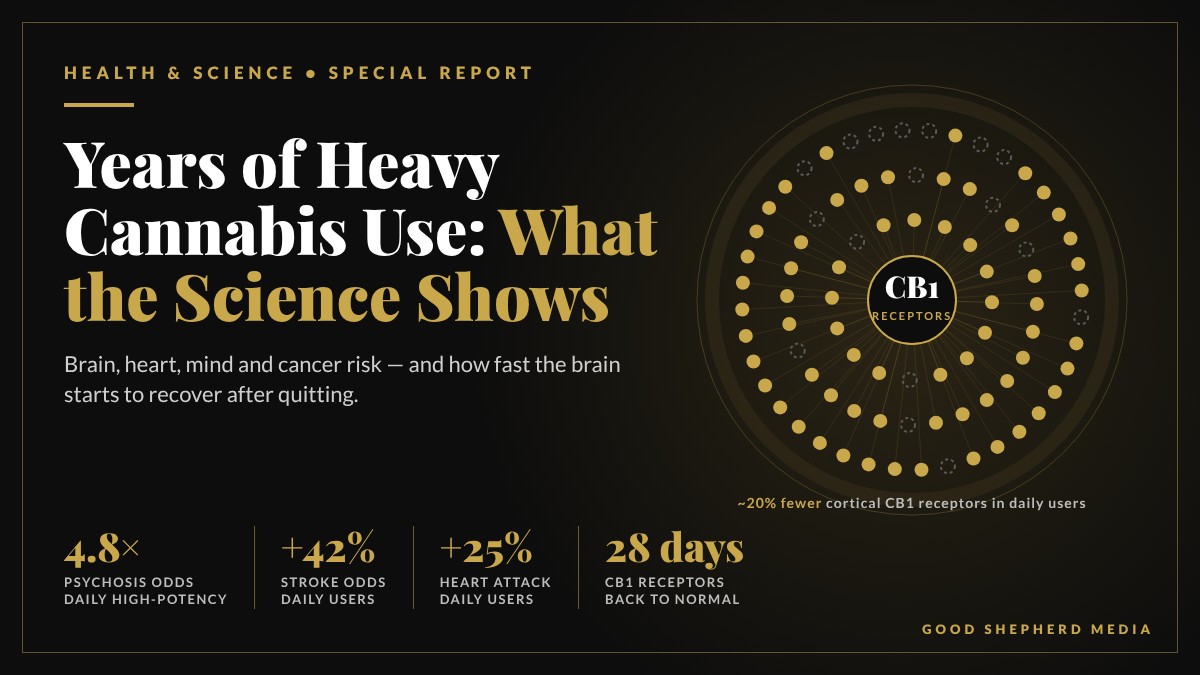
Health & Science • Special Report
What Years of Heavy Cannabis Use Do to the Brain and Body — What the Science Actually Shows
From receptor shutdown in the brain to psychosis, heart attack, stroke and cancer, a decade of peer-reviewed research paints a clear picture of daily, high-potency use. The good news: some of the damage starts to reverse within days of quitting.
By Philip, Good Shepherd Media • October 28, 2026
Cannabis is now sold legally on Main Streets across California, often at strengths that would have been unrecognizable a generation ago. Federal drug-testing labs at the University of Mississippi, which analyze marijuana seized by the DEA, found the average THC content of seized plant material climbed from about 4 percent in 1995 to about 12 percent by 2014, and to roughly 14 percent by 2019. Concentrates and vape oils run far higher.
That shift matters, because the research that follows keeps pointing to the same two risk factors: how often a person uses, and how strong the product is. Occasional adult use is a different exposure from years of daily, high-THC use. This report is about the second one.
1. The brain turns down its own cannabinoid receptors
THC works by binding to the brain’s CB1 receptors — the same receptors the body’s own endocannabinoid system uses to regulate mood, appetite, memory, pain and sleep. Flood those receptors every day and the brain defends itself by pulling some of them out of service, a process called downregulation. That is the biological root of tolerance: the same dose stops working, so users take more.
Two brain-imaging studies measured this directly in living people using PET scans:
- National Institutes of Health, 2012 (Molecular Psychiatry, Hirvonen and colleagues, including NIDA director Nora Volkow). Thirty men who smoked cannabis daily had roughly 20 percent fewer available CB1 receptors in the brain’s cortex than non-users. The deeper brain regions and cerebellum were not significantly affected. The more years a man had smoked, the greater the loss.
- Yale University, 2016 (Biological Psychiatry: CNNI, D’Souza and colleagues). Cannabis-dependent men aged 18 to 35 showed about 15 percent lower CB1 availability than healthy controls.
How long until the receptors come back?
Here the science carries genuinely encouraging news. The receptor loss is reversible, and recovery starts fast.
| Time without cannabis | What the brain scans showed |
|---|---|
| Day 1 to Day 2 | Receptors begin returning almost immediately. In the Yale study, the difference between users and non-users was no longer statistically significant after just 2 days of monitored abstinence — though the gap had not fully closed. |
| Days 2 to 6 | Withdrawal peaks: irritability, anxiety, poor sleep, vivid dreams, low appetite. In the Yale study, people with fewer receptors at day 2 reported worse withdrawal. |
| About 4 weeks (28 days) | Receptor levels measured in the normal range. The NIH team found cortical CB1 density back to normal after about four weeks on a locked research unit; the Yale team found no significant difference from non-users at day 28. |
| Beyond 4 weeks | Receptor numbers may be back, but some withdrawal symptoms — especially disturbed sleep in heavy users — can last 3 weeks or longer. For people who began using heavily as teenagers, long-term studies show thinking and memory may not fully recover (see Section 4). |
2. Addiction is real — and so is withdrawal
The old line that “weed isn’t addictive” does not survive the data. The Centers for Disease Control and Prevention estimates that roughly 3 in 10 people who use cannabis have cannabis use disorder, the medical term for problem use that a person cannot control despite harm to health, work or relationships. Risk is higher for those who start before age 18.
A 2022 clinical review in the journal Addiction found that about half of regular and dependent users go through a recognizable withdrawal syndrome when they stop. Symptoms usually begin within one to two days, peak between days two and six, and in heavy users some last three weeks or more. The authors note the clinical danger: withdrawal itself drives people back to using.
3. Psychosis and schizophrenia: the strongest evidence of harm
In 2017 the National Academies of Sciences, Engineering, and Medicine — after reviewing more than 10,000 studies — rated the link between cannabis use and the development of schizophrenia and other psychoses as supported by substantial evidence, one of its highest categories.
Later research sharpened the picture:
- Europe and Brazil, 2019 (The Lancet Psychiatry, Di Forti and colleagues, King’s College London). Comparing 901 patients with a first psychotic episode to 1,237 people from the same 11 cities, daily users had about 3.2 times the odds of a psychotic disorder compared with people who never used. For daily use of high-potency cannabis (above 10 percent THC), the odds rose to 4.8 times. The researchers estimated that about 12 percent of first-episode psychosis cases across the sites might have been prevented if high-potency cannabis were not available.
- Canada, 2025 (JAMA Network Open, Myran and colleagues, University of Ottawa). Tracking the health records of 13.5 million Ontario residents from 2006 to 2022, researchers found the share of new schizophrenia cases associated with cannabis use disorder rose from about 4 percent before legalization to about 10 percent after. Among young men, the figure reached roughly 18 percent. About 9 percent of people treated for cannabis use disorder went on to develop schizophrenia, versus 0.6 percent of people without it.
The Ontario authors are careful to say their study does not by itself prove cannabis causes schizophrenia. But the combination — a dose-response pattern, a potency effect, and rising rates as products got stronger and more available — is exactly what public-health researchers look for.
4. Teenage brains: the IQ that did not come back
The Dunedin Study in New Zealand has followed 1,037 people from birth since 1972. Because participants took IQ and memory tests at age 13 — before anyone used cannabis — and again at age 38, researchers could measure change inside the same person.
Published in the Proceedings of the National Academy of Sciences in 2012, the findings were stark: the most persistent users who started as teenagers lost an average of 8 IQ points between childhood and adulthood, while non-users held steady. Friends and family independently reported more attention and memory problems in those users. Quitting later in life did not fully restore lost function. People who began heavy use only as adults did not show the same decline.
The honest caveat: the group of heavy adolescent-onset users was small, about 50 people. But the finding fits the biology — the brain is still wiring itself until the mid-twenties.
5. Heart attack and stroke
A 2024 study in the Journal of the American Heart Association, led by researchers at Massachusetts General Hospital and drawing on CDC survey data from about 430,000 U.S. adults (2016–2020), found that daily cannabis users had:
- 25 percent higher odds of heart attack
- 42 percent higher odds of stroke
The link held even among people who had never smoked tobacco or used e-cigarettes. Most users in the survey smoked their cannabis. The data were self-reported, and the authors called for long-term follow-up studies.
6. Uncontrollable vomiting sending users to the ER
Cannabinoid hyperemesis syndrome — repeated bouts of severe nausea, vomiting and abdominal pain in long-term heavy users — was once a medical curiosity. In Ontario, a 2022 study in JAMA Network Open found emergency-room visits for the condition rose 13-fold between 2014 and mid-2021, with the sharpest jump after the retail market expanded. Nearly 1 in 11 of those visits ended in hospital admission. The only reliable cure is stopping.
7. Head and neck cancer
A 2024 study from the Keck School of Medicine of USC, published in JAMA Otolaryngology–Head & Neck Surgery, compared about 116,000 adults diagnosed with cannabis use disorder against matched patients without it, after accounting for tobacco and alcohol use. Those with the disorder had about 3.5 times the risk of head and neck cancer, with laryngeal cancer showing the largest increase. The researchers point to the smoke itself as the likely culprit and say the mechanism and dose still need study.
8. Dementia later in life
In April 2025, the University of Ottawa team published a study in JAMA Neurology following 6 million Ontario adults aged 45 and older. People whose cannabis use was serious enough to land them in an emergency room or hospital had 72 percent higher risk of a new dementia diagnosis within five years compared with the general population, and 23 percent higher risk than people hospitalized for other reasons, after adjusting for other health conditions. Within five years, 5.0 percent of the cannabis group had been diagnosed with dementia, versus 1.3 percent of the general population. The risk was still lower than for people hospitalized for alcohol, and the authors stress the study shows an association, not proof of cause.
What the science does not say
Good reporting means stating the limits. Most of the studies above are observational: they show strong, repeated associations, not laboratory proof of cause. The heaviest harms track with daily, high-potency, often smoked use, and with starting young. The same 2017 National Academies report that found substantial evidence of psychosis risk also found substantial evidence that cannabis can help some adults with chronic pain, chemotherapy nausea and multiple sclerosis spasms, and it did not find an established link to lung cancer.
What the record does show is that the image of cannabis as harmless does not match the medical literature — and that today’s products are not the cannabis most of that earlier reassurance was based on.
If you or someone you love wants to stop
The first week is the hardest; withdrawal usually peaks by day six and the brain’s receptors are measurably recovering within about a month. Free, confidential help is available 24 hours a day, 365 days a year through the SAMHSA National Helpline: 1-800-662-4357, or online at findtreatment.gov.
Sources
- Hirvonen J, et al. “Reversible and regionally selective downregulation of brain cannabinoid CB1 receptors in chronic daily cannabis smokers.” Molecular Psychiatry 17 (2012): 642–649. pubmed.ncbi.nlm.nih.gov/21747398
- D’Souza DC, et al. “Rapid Changes in CB1 Receptor Availability in Cannabis Dependent Males after Abstinence from Cannabis.” Biological Psychiatry: CNNI 1 (2016): 60–67. pmc.ncbi.nlm.nih.gov/articles/PMC4742341
- Connor JP, et al. “Clinical management of cannabis withdrawal.” Addiction 117 (2022): 2075–2095. pubmed.ncbi.nlm.nih.gov/34791767
- Budney AJ, et al. “The time course and significance of cannabis withdrawal.” J Abnorm Psychol 112 (2003): 393–402. pubmed.ncbi.nlm.nih.gov/12943018
- CDC. “Understanding Your Risk for Cannabis Use Disorder.” cdc.gov/cannabis/health-effects/cannabis-use-disorder.html
- National Academies of Sciences, Engineering, and Medicine. The Health Effects of Cannabis and Cannabinoids (2017). doi.org/10.17226/24625
- Di Forti M, et al. “The contribution of cannabis use to variation in the incidence of psychotic disorder across Europe (EU-GEI).” The Lancet Psychiatry (2019). doi.org/10.1016/S2215-0366(19)30048-3
- Myran DT, et al. “Changes in Incident Schizophrenia Diagnoses Associated With Cannabis Use Disorder After Cannabis Legalization.” JAMA Network Open (2025). doi:10.1001/jamanetworkopen.2024.57868
- Meier MH, et al. “Persistent cannabis users show neuropsychological decline from childhood to midlife.” PNAS 109 (2012): E2657–64. doi.org/10.1073/pnas.1206820109
- Jeffers AM, et al. “Association of Cannabis Use With Cardiovascular Outcomes Among US Adults.” Journal of the American Heart Association (2024).
- Myran DT, et al. “Changes in Emergency Department Visits for Cannabis Hyperemesis Syndrome Following Recreational Cannabis Legalization and Subsequent Commercialization in Ontario, Canada.” JAMA Network Open 5 (2022): e2231937.
- Gallagher TJ, Kokot NC, et al. “Cannabis Use and Head and Neck Cancer.” JAMA Otolaryngology–Head & Neck Surgery (2024). doi:10.1001/jamaoto.2024.2419
- Myran DT, et al. “Risk of Dementia in Individuals With Emergency Department Visits or Hospitalizations Due to Cannabis.” JAMA Neurology (2025). pubmed.ncbi.nlm.nih.gov/40227745
- ElSohly MA, et al. “Changes in cannabis potency over the last two decades (1995–2014).” Biological Psychiatry 79 (2016); and “A 10-year trend in cannabis potency (2013–2022).” Frontiers in Public Health 12 (2024).
This article is journalism summarizing published research and is not medical advice. Talk to a doctor before making health decisions. © 2026 Good Shepherd Media.