

Good Shepherd Media • Business & Accountability
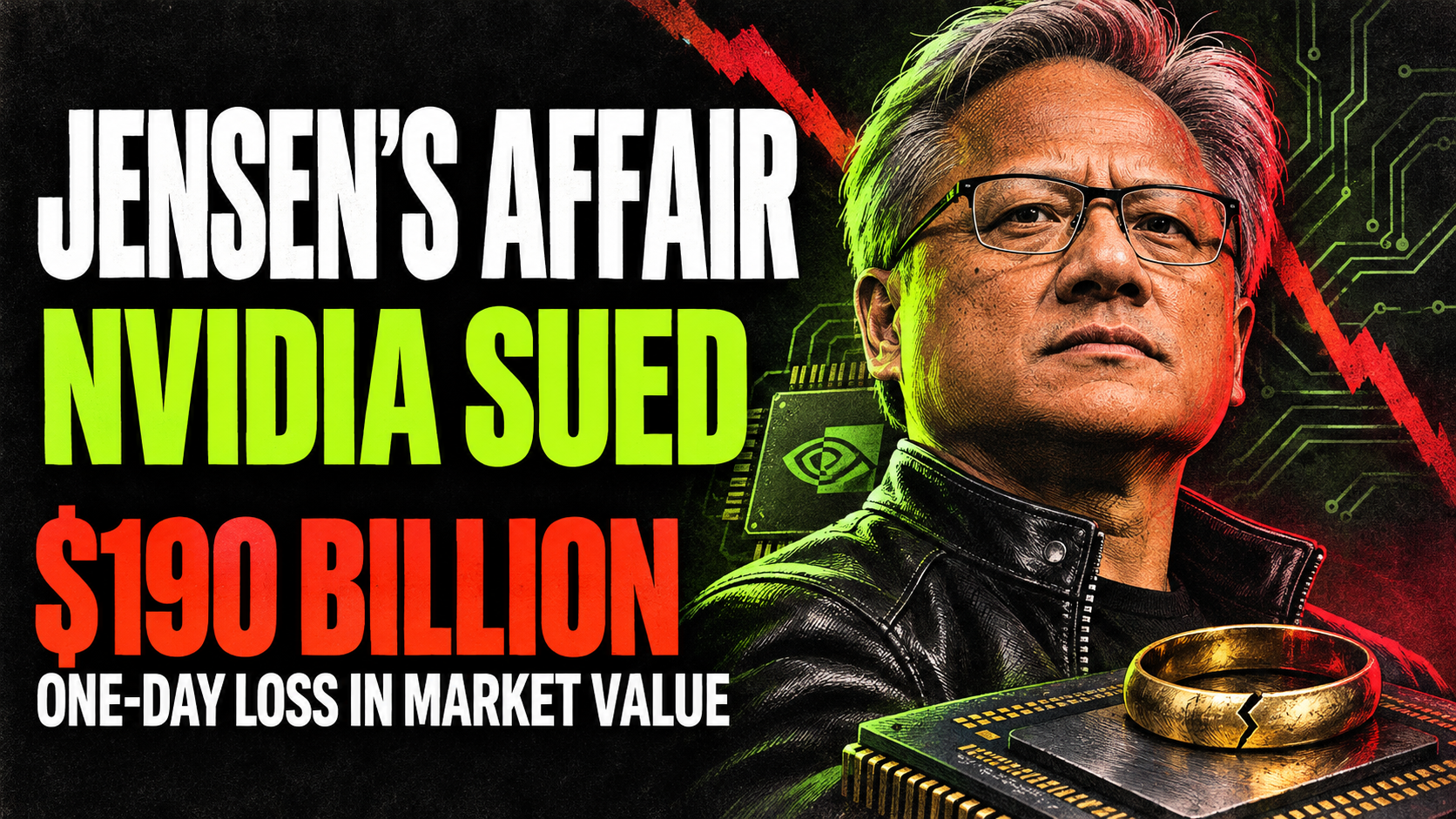
$190 Billion Gone in a Day: Shareholder Sues Nvidia and Jensen Huang Over Affair With a Suspected Chinese Spy
The first federal class action landed five minutes after the closing bell. It says the company told the public the relationship was ordinary business while its chief executive knew otherwise.
By Philip, Good Shepherd Media • November 10, 2026
A retail investor has filed the first federal securities class action against Nvidia Corporation and its chief executive, Jensen Huang, accusing them of misleading shareholders about Huang’s relationship with a woman United States intelligence reportedly believes was gathering information for Beijing.
The case is Kistenmacher v. NVIDIA Corporation et al., No. 5:26-cv-13448, filed Monday, November 9, 2026, in the United States District Court for the Northern District of California, San Jose. Reuters reported the complaint hit the docket about five minutes after the stock market closed — on a day Nvidia shares fell $7.97, or 4.27 percent, to $178.67, erasing roughly $190 billion in market value.
The case at a glance
Plaintiff: Mark Kistenmacher, individual investor, on behalf of a proposed class
Defendants: NVIDIA Corporation; Jen-Hsun (“Jensen”) Huang
Court: U.S. District Court, Northern District of California (San Jose)
Case number: 5:26-cv-13448 • filed November 9, 2026
Claims: Securities Exchange Act Section 10(b) and Rule 10b-5 (both defendants); Section 20(a) (Huang)
Proposed class period: October 9, 2025 through November 8, 2026
Relief sought: Unspecified damages, interest, attorneys’ fees, jury trial
Plaintiff’s counsel: Laurence M. Rosen, The Rosen Law Firm, P.A., Los Angeles
What the complaint says
The 17-page complaint does not sue over the affair itself. It sues over what the company said about it. The theory is that Nvidia made public statements about its customer Megaspeed and about Huang’s dealings with Megaspeed executive Alice Huang — no relation — that left out a fact any investor would want to know.
The filing points to four statements. Two came in an October 9, 2025 New York Times report, where a company spokesman said Nvidia had found no evidence its chips were being smuggled into China and described Megaspeed as a small commercial cloud operator. The third came on October 29, 2026, when the same spokesman characterized the chief executive’s interactions with Alice Huang as “not unusual or unexpected.” The fourth is attributed to Jensen Huang himself, in an October 30, 2026 Bloomberg report, calling the Megaspeed relationship normal.
Each of those, the complaint alleges, was materially false or misleading when made because Huang was in an intimate relationship with a Megaspeed executive suspected of helping move restricted Nvidia products into China. Had the market known, the plaintiff argues, investors would not have paid the prices they paid.
How it came apart
On Sunday, November 8, Nvidia’s board announced an independent investigation, run by independent directors with outside counsel, into reports that Huang had been the target of a foreign intelligence effort. The board said it had no reason to believe national security or company secrets were compromised and expressed confidence in Huang.
The same day, Huang, 63, told employees in a memo that he had been unfaithful to his wife of four decades, apologized, and pledged to cooperate with the review. He did not name the woman.
President Donald Trump said Monday the FBI is looking into the matter, and that Huang told him he had no idea the woman might be involved in espionage. Trump added that he expects Huang will “be in good shape.” House Republicans have asked Huang for a closed-door briefing, and Democrats including Sen. Mark Warner and Rep. Hakeem Jeffries have signaled interest in their own inquiries.
The money trail: $4.8 billion, then $7.5 billion
The stakes are not limited to embarrassment. The Times has reported that Megaspeed purchased more than $4.8 billion of Nvidia chips over two years, and that the Commerce Department examined whether the Singapore company was helping Chinese firms sidestep American export controls.
On Tuesday, The Information went further. Citing two people who know Alice Huang, it reported that she, her husband and her sister built a web of companies in China and Singapore that helped move about 240,000 restricted Nvidia chips — worth at least $7.5 billion — into China, with some of that computing power ultimately serving Alibaba, Tencent and smaller Chinese AI labs. Reuters relayed the report and said Nvidia did not immediately respond. Good Shepherd Media has not independently verified those figures.
China’s government has rejected the espionage allegation as unsubstantiated. Alice Huang has not been charged with any crime.
A $20,500 plaintiff and a race to the courthouse
Kistenmacher is not a hedge fund. According to TechCrunch’s review of his filing, he made seven Nvidia purchases this year totaling roughly $20,500. That is typical of how these cases begin: the first complaint triggers a public notice, and other investors then have 60 days to ask the court to be named lead plaintiff. The court usually picks whoever lost the most — often a pension fund — and that investor’s lawyers take over the case.
That is why the plaintiffs’ bar moved within hours. Besides Rosen, at least five other firms — Schall, Brown & Schwartz; Levi & Korsinsky; Bronstein, Gewirtz & Grossman; and the Law Offices of Frank R. Cruz among them — announced “investigations” on Monday. Readers should understand what those announcements are: advertising for clients, not findings of wrongdoing.
What it means for ordinary shareholders
Stanford Law professor Robert Bartlett told TechCrunch the case fits the classic “fraud on the market” mold, and that he views the company’s earlier description of the relationship as misleading, with Huang’s own knowledge attributable to the company he runs. He also offered the sober part: these cases run for years, almost always settle, and the settlement is paid by the company and its insurers — meaning current shareholders largely pay former shareholders, while executives rarely pay anything personally.
There is a real defense, too. Nvidia will argue that a spokesman’s remarks to reporters about a customer relationship are not the kind of statement securities law punishes, that a chief executive’s private life is not automatically a required disclosure, and that the plaintiff must prove Huang knew of any intelligence connection — something Huang, through the President, has flatly denied. Federal law sets a high pleading bar for exactly this kind of case, and many are dismissed before discovery.
Wall Street, for now, is betting on survival. Analyst Dan Ives put the market’s read at about a 15 percent chance Huang is removed. The stock fell again Tuesday morning.
Our view
Millions of Americans own Nvidia whether they chose to or not — it sits at the top of nearly every index fund and retirement account in the country. They were told a relationship was “not unusual.” Ten days later the chief executive admitted it was an affair, the board hired outside lawyers, and the FBI was involved. Whether that gap amounts to securities fraud is for a federal judge and, perhaps, a jury. Whether it amounts to a failure of candor toward the people who own the company is a question shareholders can answer for themselves.
The allegations in the complaint are allegations. No court has ruled on them, and Nvidia and Huang have not yet answered in court.
Point of contact for Mark Kistenmacher
- Attorney of record: Laurence M. Rosen, The Rosen Law Firm, P.A.
- Address: 355 South Grand Avenue, Suite 2450, Los Angeles, CA 90071
- Phone: (213) 785-2610
- Toll-free: (866) 767-3653
- Fax: (213) 226-4684
- Email: lrosen@rosenlegal.com
Sources
Class Action Complaint, Kistenmacher v. NVIDIA Corp. (N.D. Cal.)
Federal docket, No. 5:26-cv-13448 (PacerMonitor)
Courthouse News Service, Nov. 9, 2026
TechCrunch, “The race is on to sue Nvidia,” Nov. 9, 2026
Associated Press, Nov. 10, 2026
Reuters via Business Insurance, Nov. 10, 2026
Reuters on The Information report, Nov. 10, 2026