

Editorial | Election 2026 | Vote by Tuesday, November 3
No on Proposition 45: The Chamber of Commerce Wrote a 41-Page Law to Cut You Out of the Room
Utilities, homebuilders and data-center money paid to put it on your ballot. The Legislative Analyst says it could cost taxpayers $100 million a year. And the one thing it does not do is lower your rent.
By Philip Zullo, Publisher · Good Shepherd Media · October 28, 2026
Every Californian who has ever stood up at a planning hearing, filed a comment on a traffic study, or asked why a developer’s evacuation plan assumed a two-lane canyon road could empty a subdivision in a wildfire has used one law to do it. It is called the California Environmental Quality Act, CEQA, and it has been on the books since 1970.
Proposition 45 would rewrite it. Not by the Legislature, where it could be fixed when it breaks, but by a 41-page initiative statute drafted by the California Chamber of Commerce’s lawyers, placed on the ballot by paid signature gatherers, and locked in so that it can only be amended by a two-thirds vote of both houses. It takes effect the moment the vote is certified.
The campaign calls it the “Building an Affordable California Act.” Read the text and you will not find a dollar of rent relief, a mortgage program, or a cap on anything you pay. What you will find is a new fast lane for a category the measure calls “essential projects,” a stopwatch on public review, a shorter leash on the courts, and a definition of “essential” wide enough to drive a server farm through.
What Prop 45 actually does
Prop 45 creates an opt-in track for eight kinds of “essential” projects: housing, water, clean energy, public health, public safety, broadband internet access, education facilities, and transportation. A developer who qualifies can choose the new track. Once on it, the agency must finish the environmental review within a fixed clock of 365 business days. Any lawsuit challenging the approval must be decided within 270 days. The court is told to defer to the agency, to interpret the measure “liberally” in favor of approving the project, and to limit what a challenger can raise. Agencies are relieved of some of their duty to respond to late public comments.
Supporters are correct that it is not a blanket exemption. Projects still have to produce an environmental document. But the practical effect, according to the state’s nonpartisan Legislative Analyst, is that state and local agencies will have to hire people and build systems to meet the deadlines, at a cost the Analyst puts in the high tens of millions of dollars a year, possibly more than $100 million. That money comes from the same general fund and city budgets that pay for deputies, road repair and fire protection.
Follow the money: $42.5 million says yes
According to the Fair Political Practices Commission’s top-contributor list and reporting compiled by KQED, the Yes on 45 effort had raised roughly $42.5 million by mid-October. The largest single source is a committee called Building a Better California, at about $10 million, whose top donors include Google co-founder Sergey Brin. The California Building Industry Association’s committee put in about $9.9 million, bankrolled by KB Home and Lennar. A Chamber-controlled business PAC gave $3.9 million, with its top donors listed as California Resources Corporation, the state’s largest oil and gas producer, and PG&E. PG&E separately funded a committee named “BRIDGE Issues PAC, Yes on 45, Funded by PG&E Corporation” with $2.3 million. Edison International, the parent of Southern California Edison, gave $2 million directly and, by the No campaign’s count of all affiliated committees, about $4 million in total.
Then there is Prologis, the San Rafael-based industrial developer that is planning five data centers in San Jose alone. State filings show its “Modern Infrastructure Alliance Action Fund” put $500,000 into Yes on 45. The No campaign puts total data-center-related money behind the measure at more than $4 million.
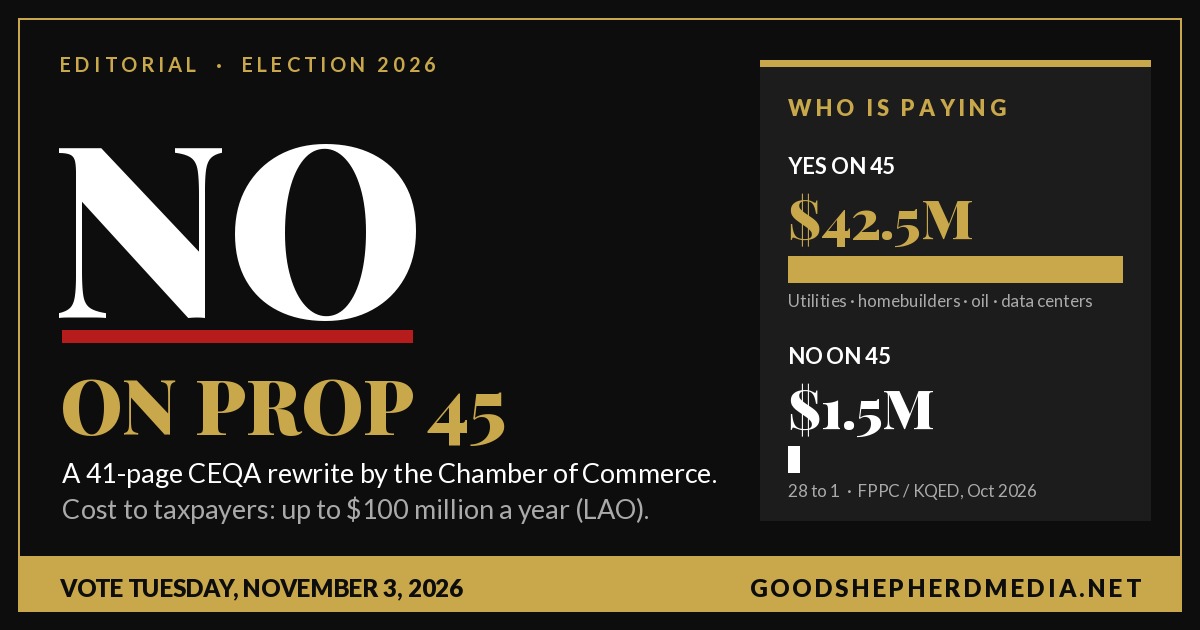
The No side, sponsored by labor, health and environmental groups, had raised about $1.5 million. Its biggest donors are an environmental coalition, philanthropist Wendy Schmidt, and the State Building and Construction Trades Council. That is a roughly 28-to-1 money gap, and you can see it in the glossy mailers arriving at Santa Clarita Valley homes this week.
Ask yourself why a utility that reported record profits of $2.47 billion last year, and another that reported $1.69 billion, would spend millions to shorten the public’s chance to object to transmission lines, substations and power plants. Ask why a company building data centers wants a shorter clock on the review of projects that draw enormous amounts of power and water. They are not doing it to lower your rent.
The data-center question
The words “data center” do not appear in Prop 45. That is exactly the problem. The measure fast-tracks “essential broadband internet access projects,” and it says an essential project “includes all related and ancillary public, private, and utility infrastructure” needed to serve it, naming electric, telecommunication, gas and water improvements. Opponents, including the Sierra Club and a coalition of land-use attorneys, argue that language is broad enough to let a data center ride the broadband lane, and that Prop 45 would hollow out the data-center rules the Legislature only just passed.
In fairness, the Yes campaign disputes this. Kurt Oneto, the Nielsen Merksamer attorney who is the measure’s official proponent, wrote that supplying the internet no more makes a data center a broadband project than supplying lumber makes a sawmill a housing project. The campaign asked the Office of Legislative Counsel, which opined that the statutory definition of “broadband internet access service” the measure borrows would not sweep in data centers.
Here is why that does not settle it. Legislative Counsel’s opinion is advice, not a court ruling, and Prop 45 itself orders judges to resolve ambiguity in favor of the project. The measure cannot be fixed by a simple majority of the Legislature if a court reads it the other way. And the people who wrote it were paid, in part, by the industry that stands to benefit from the broad reading. When a law’s authors insist a loophole is not there, the honest test is whether they would accept an amendment closing it. They wrote the measure so that no such amendment is possible without a two-thirds vote. Voters should not be asked to take the drafters’ word for what their own text means.
The “housing” sales pitch
The ballot argument leans hard on housing. The Building Industry Association claims Prop 45 would take $75,000 off the price of a new home. That figure is the industry’s own estimate of total permitting delay, not a promise, and nothing in the measure requires a builder to pass a single dollar of savings to a buyer or renter. Prop 45 sets no rent, builds no home, and appropriates no money for housing. Even California YIMBY, the state’s loudest pro-housing group, declined to endorse it, noting that the measure’s main housing effect is to help large new subdivisions that do not already qualify for the infill exemptions the Legislature adopted in 2025.
What the measure does do is define “essential housing project” to include not just apartments and single-family tracts but transitional housing, emergency shelters, supportive housing, farmworker housing, group living facilities, student and senior housing, and conversions of commercial buildings. Those are overwhelmingly publicly funded projects. Prop 45 then exempts 100 percent affordable projects under 85 feet from the labor standards it imposes on everyone else. In plain terms: the taxpayer-financed projects get the fastest lane, with the thinnest public review, and the neighbors who pay for them lose the comment rights they have today. If you think the public should have more say over where a state-funded shelter or supportive-housing complex goes, not less, Prop 45 moves in the wrong direction.
Readers who want to weigh the actual taxpayer housing question on this ballot should look at Proposition 1, the $11.25 billion housing bond. That is where the money is. Prop 45 is about who gets to object, and for how long.
Why it matters in Santa Clarita
This valley is a place where the environmental review is often the only room the public is allowed into. The City Council meets at hours most working people cannot attend. Staff reports arrive days before a vote. The CEQA comment period, the traffic study, the fire-evacuation analysis and the lawsuit that follows when the city ignores them are the tools canyon residents have used for forty years to force an honest accounting of what a project does to a two-lane road, a water table or a wildfire corridor. Prop 45 puts those tools on a timer set by the developer’s lawyers and tells the judge to lean toward the developer when the clock runs out.
CEQA is abused. Everyone who has watched a union use it to extract a labor agreement, or a competitor use it to stall a rival, knows that. The Legislature has been cutting back the abuse for a decade, most recently with the 2025 infill reforms. Those changes can be adjusted by a majority vote when they misfire. Prop 45 cannot. It hands a corporate coalition a permanent rewrite and asks the rest of us to trust the fine print.
The Sierra Club, the California Nurses Association, the League of Women Voters, the Western Center on Law and Poverty and the California Democratic Party say no. So does this newspaper. The California Chamber of Commerce, the California Republican Party, the hospital and water associations, and Assemblymember Buffy Wicks say yes. Their argument is that the current system is slow, expensive and litigious, and they are not wrong about that. The question is whether the cure should be written by the people who profit from it and placed beyond the reach of ordinary repair. It should not.
Fix CEQA in the Legislature, in daylight, where a mistake can be corrected next session. Do not let the people who profit from the shortcut write it into permanent law.
Vote No on Proposition 45.
Prop 45 at a glance
Yes creates an optional fast-track environmental review for eight kinds of “essential” projects, with a 365-business-day review limit and a 270-day limit on lawsuits. No keeps current CEQA law, including the 2025 infill reforms. Cost: high tens of millions to over $100 million a year for state and local agencies (Legislative Analyst). Raised: Yes about $42.5 million; No about $1.5 million.
How to vote
Election Day is Tuesday, November 3, 2026. Mail ballots went to every registered voter in October. A mailed ballot must be postmarked on or before November 3 and received within seven days. Drop boxes and vote centers are listed at lavote.gov. Registration closed October 19, but same-day conditional registration is available at any vote center through Election Day.
Sources
- California Secretary of State, Official Voter Information Guide, Proposition 45
- Proposition 45, Text of Proposed Law (41 pages)
- Fair Political Practices Commission, Top 10 Contributors, November 2026 General Election
- KQED 2026 Voter Guide, Proposition 45 (fundraising totals)
- CalMatters, “Prop 45 explained: CEQA overhaul could shift who holds power over building”
- LA Public Press, “Critics worry about a potential data center loophole”
- The San Francisco Standard, “Prop. 45 promises more housing. Why are some YIMBYs against it?”
- California YIMBY, “Proposition 45: No Recommendation”
- Lexology, Legislative Counsel opinion on data centers and the broadband definition
- Courage California, PG&E and Edison contributions and 2025 profits
- LA Progressive / Capital & Main, California Resources Corp. contributions
- No on Prop 45, Prologis contributions (campaign source)
- Yes on Prop 45, “Read the Measure” (campaign source)
- California Environmental Voters, “What is Proposition 45?”