

<!doctype html>
GOOD SHEPHERD MEDIA | OPINION
California Funds Drug Pipes and Keeps Jail on the Books
Gavin Newsom and Sacramento Democrats owe families an accounting of what the state buys, who still faces prosecution, and how quickly a child can get treatment.
By Lead reporters: D. Collins & G. Chen |
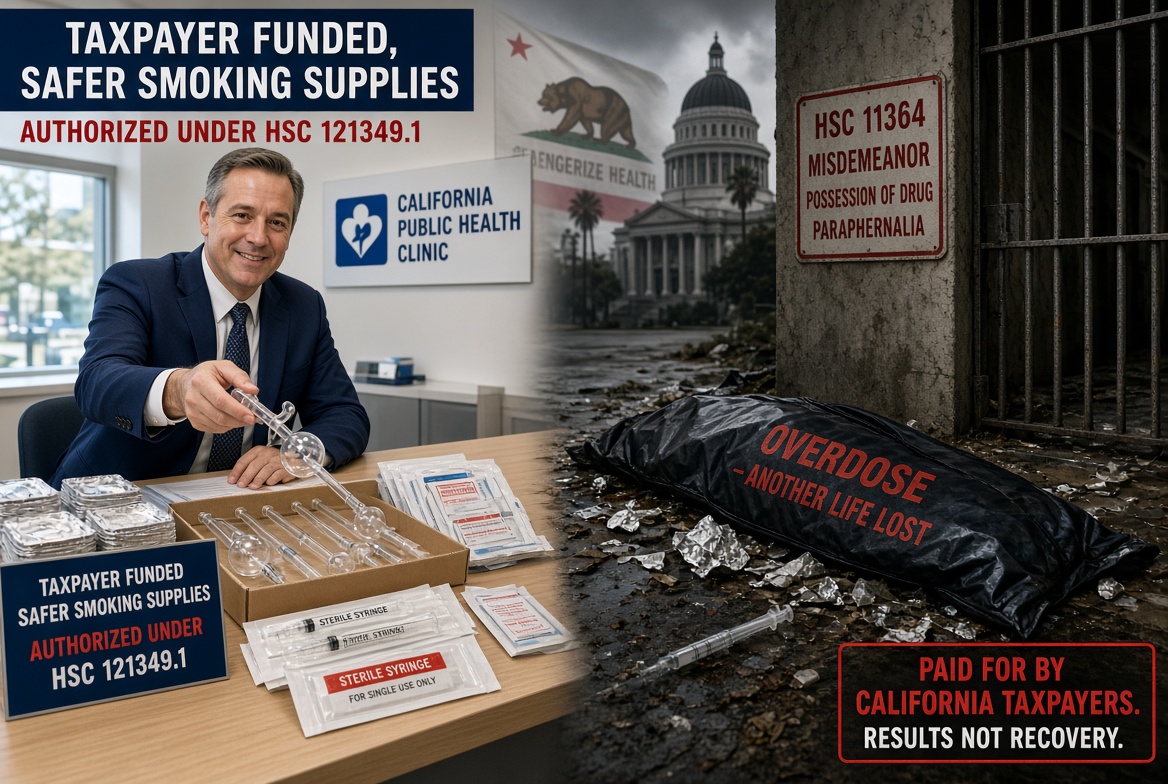
In California, an authorized syringe services program can hand someone a glass pipe designed for smoking methamphetamine. A person who knowingly possesses a pipe used for unlawful drug use can face a misdemeanor and up to 180 days in county jail if no exemption applies. Where the pipe came from can determine whether possessing it is a crime. That’s the policy Sacramento has chosen to keep.
California Department of Public Health legal guide Health and Safety Code § 11364 California jury instruction on paraphernalia possession Health and Safety Code § 11374
The state built this system and keeps paying for it
The 2015–16 state budget put $3 million a year from the General Fund toward statewide syringe exchange supplies. In 2018, under Gov. Jerry Brown, Assembly Bill 1810 broadened the law to cover other supplies designated by health officials. In December 2019, during Newsom’s first year in office, the California Department of Public Health designated smoking supplies for distribution. The state’s published supply list includes straight glass pipes, glass bulb pipes, and foil.
2015–16 state budget CDPH guidance on the 2018 law and 2019 designation CDPH supply list
Newsom signed Senate Bill 159 in 2024, allocating $10 million a year for three years to the Harm Reduction Supply Clearinghouse from the state’s AIDS Drug Assistance Program Rebate Fund. This June he signed Senate Bill 164, which makes another $10 million a year available for three years starting July 1, 2027. Fifty-six Assembly Democrats voted for the 2026 bill. Fourteen Assembly Republicans voted against it.
2024 Senate Bill 159, § 83 California Senate’s 2026 budget report Governor’s signing announcement Assembly roll call
Those sums cover the clearinghouse as a whole. The Department of Public Health reported spending $1.6 million of the first $10 million in fiscal year 2024–25. Its budget estimate leaves the cost of pipes and foil unitemized. Sacramento should publish that figure.
CDPH expenditure estimate
Who can still face a charge?
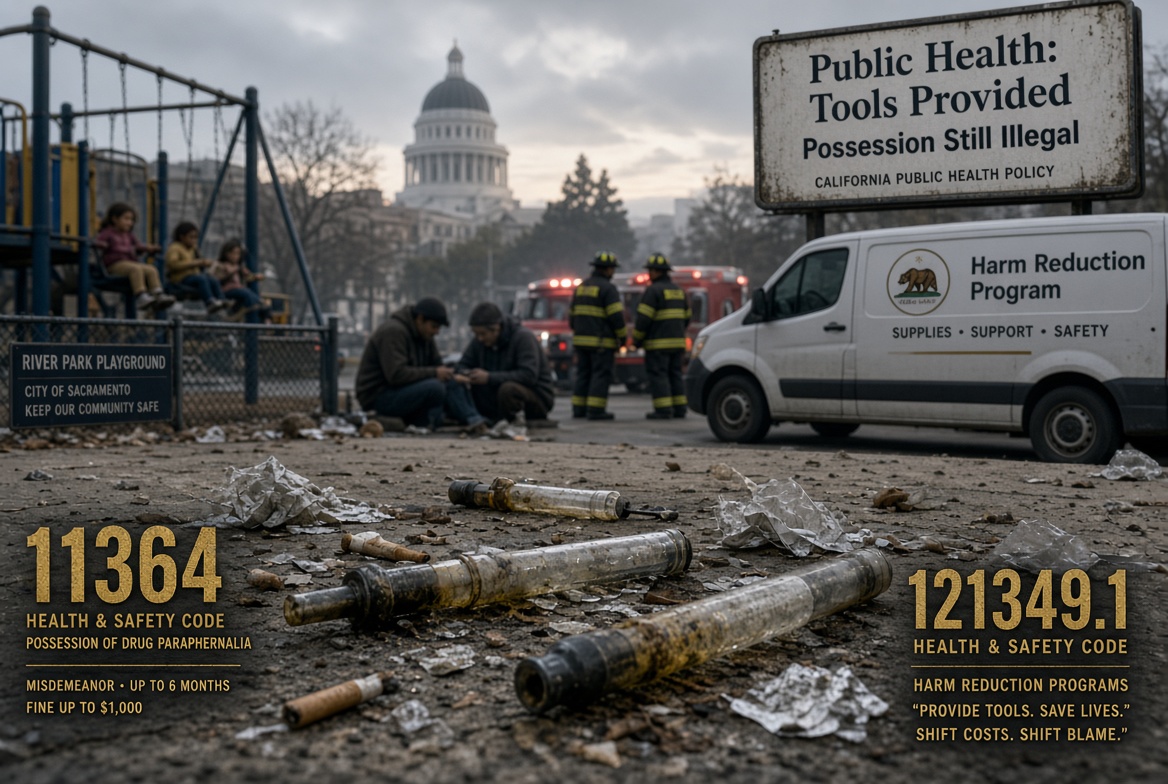
Health and Safety Code § 121349.1 protects people who get designated supplies from an authorized exchange from prosecution for possessing those supplies. The state says participants can rely on that protection without carrying paperwork. Outside the exemption, § 11364 remains enforceable. In January, Watsonville police recorded a paraphernalia arrest that ended in a citation and release. In November, Signal Hill’s booking log listed paraphernalia alongside a separate drug possession allegation. The logs leave the source of the items unspecified.
Health and Safety Code § 121349.1 CDPH guidance on the 2018 law and 2019 designation Watsonville police log Signal Hill booking log
Possessing the drugs themselves is a separate issue. California’s jury instructions require proof of a usable amount for a simple possession conviction. Unusable traces or debris fall short. For paraphernalia possession, § 11374 sets a base fine of $30 to $500. People who qualify for pretrial diversion under Penal Code § 1000 can have a paraphernalia charge dismissed after successful completion.
California jury instruction on drug possession Health and Safety Code § 11374 California’s drug diversion law Dismissal after successful diversion

What California’s families are up against
In Santa Clarita, parents who lost children to fentanyl have shared their stories through the city’s prevention campaign. In Los Angeles County, nine children and teens age 17 or younger died of accidental fentanyl overdoses in 2025, down from 13 in 2024. A separate state report counted 15 fentanyl-related deaths among California children age five or younger in 2023. Twelve of those exposures happened at home.
Santa Clarita’s Parenting for Prevention campaign Los Angeles County fentanyl overdose report California report on fentanyl deaths among young children
The CDC reports that fentanyl was involved in 75% of U.S. overdose deaths among people ages 10 to 19 from 2020 through 2024. A counterfeit pill can expose a teenager to fentanyl when they believe they’re taking a prescription drug. California’s all-age overdose death rate fell 21% in 2024 after climbing sharply through 2023. Those figures establish the scale of the danger. To learn whether distributing pipes changes youth overdose risk, California would need research that accounts for changes in the illicit drug supply and other factors.
CDC youth fentanyl data California’s 2026 public health report
Public health officials have a reason to offer clean equipment to people already using drugs. Sharing equipment can spread infection. Health officials also aim to reduce injection-related injuries by helping people move away from injecting. A 2023 review found studies reporting less pipe sharing and less use of broken equipment after supplies were provided. The authors called for more research on how well these programs work, particularly in the United States.
CDPH guidance on the 2018 law and 2019 designation 2023 review of safer smoking programs
When open drug use becomes routine on a child’s walk to school, families are entitled to ask what message it sends and how officials respond to discarded supplies and public drug use. Los Angeles County told LAist it paused pipe and syringe distribution at its Skid Row Care Campus in August, partly in response to concerns raised by community members and local businesses. The campus kept offering naloxone, and staff referred people to other syringe programs.
LAist reporting on the Skid Row Care Campus

Show families how people get into treatment
A 2022 state assessment reported that 45 counties lacked enough residential beds for youth needing substance-use treatment. In October, Newsom announced more than $21 million for outreach, overdose prevention and connections to care. Families deserve current county-by-county figures showing how long young people wait for a first appointment and how many get into treatment after a referral.
2022 California treatment assessment Governor’s October 2026 announcement
San Francisco already requires city-funded programs distributing supplies to offer counseling and help people connect to treatment. Sacramento should require programs it funds to report how many referrals become appointments and how many people begin care. Give families a clear way to report discarded equipment and public drug use. End jail as a penalty for possession of a pipe alone and put that effort into getting people to care and pursuing the dealers who sell counterfeit pills.
San Francisco Department of Public Health policy
G. Chen — Technology • Disinformation Reporter
Bay Area, CA
 D Collins – Investigative Reporter
Governor Newsom and the Democrats who renewed this funding should be able to answer a parent who calls tonight and says, “My child is using fentanyl. Where can we go tomorrow?”