

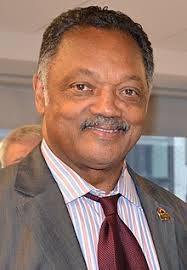
US civil rights leader Jesse Jackson dies aged 84
US civil rights leader Jesse Jackson died aged 84 on Tuesday morning surrounded by relatives, according to a statement released by his family.
“It is with profound sadness that we announce the passing of Civil Rights leader and founder of the Rainbow PUSH Coalition, the Honorable Reverend Jesse Louis Jackson, Sr,” the family said, adding that he died “peacefully”.
The cause of his death has not been released, but Jackson had been diagnosed with progressive supranuclear palsy (PSP) and was in hospital late last year.
Tributes poured in for the prominent activist, who twice ran to be the Democratic presidential nominee, including from the first black US president, Barack Obama.
Jackson is survived by his wife Jacqueline and their children: Santita, Jesse Jr, Jonathan, Yusef, Jacqueline and Ashley.
Jackson’s family said in their statement that his “unwavering commitment to justice, equality and human rights helped shape a global movement for freedom and dignity”.
“A tireless change agent, he elevated the voices of the voiceless from his presidential campaigns in the 1980s to mobilising millions to register to vote – leaving an indelible mark on history,” they added.
Alongside working with Martin Luther King Jr and running for president in 1984 and 1988, Jackson is remembered as the founder of a non-profit organisation focused on social justice and civil rights, the Rainbow PUSH coalition.
Calling Jackson a “true giant”, Obama said in a statement that Jackson’s “two historic runs for president” had “laid the foundation for my own campaign to the highest office of the land”.
Obama added that his wife Michelle “got her first glimpse of political organising at the Jacksons’ kitchen table when she was a teenager”.
“For more than 60 years, Reverend Jackson helped lead some of the most significant movements for change in human history,” the Obamas also said.
“From organising boycotts and sit-ins, to registering millions of voters, to advocating for freedom and democracy around the world, he was relentless in his belief that we are all children of God, deserving of dignity and respect.”
Jackson was admitted to hospital last November, and doctors said he had been diagnosed with a rare degenerative condition called PSP in April 2025, revising an earlier diagnosis of Parkinson’s disease that Jackson had said was made in 2015.
Both diseases affect the brain, nervous system and muscle control. Many people with PSP are initially diagnosed with Parkinson’s because a number of the symptoms overlap, according to the American Parkinson Disease Association and the group CurePSP.
Born in 1941 in Greenville, South Carolina, Jackson became involved in politics at an early age. He rose to prominence in the 1960s as a leader in Martin Luther King Jr’s Southern Christian Leadership Conference and was with King when he was assassinated in Memphis, Tennessee in 1968.
Over the course of his career, Jackson built a movement to bring America’s increasingly diverse population together, with a message that centred on poor and working-class Americans.
After his presidential runs, Jackson later positioned himself as an elder statesman within the Democratic Party.
His son Jesse Jackson Jr is a former US congressman.
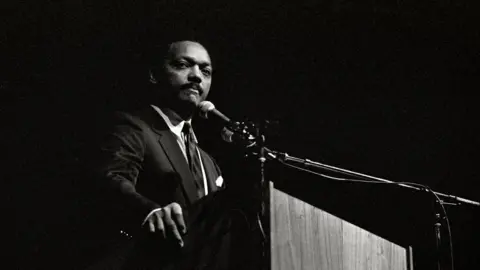 Getty Images
Shortly after his death was announced, politicians and other public figures took to social media to mourn the loss of Jackson.
US President Donald Trump said he knew Jackson “long before becoming president”.
“He was a good man, with lots of personality, grit, and ‘street smarts,'” Trump said. “He was very gregarious – Someone who truly loved people!”
Former US President Bill Clinton and his wife Hillary, a former secretary of state, also shared tributes, saying they were friends with Jackson for “almost 50 years”.
“Reverend Jackson championed human dignity and helped create opportunities for countless people to live better lives,” they said.
House of Representatives Minority Leader Hakeem Jeffries wrote on X that Jackson “was a legendary voice for the voiceless”.
The Democrat added: “For decades, while labouring in the vineyards of the community, he inspired us to keep hope alive in the struggle for liberty and justice for all.”
New York City Mayor Zohran Mamdani said the civil rights leader “never stopped demanding that America live up to its promise”.
“He marched, he ran, he organised and he preached justice without apology,” Mamdani said.
King’s daughter Bernice said Jackson had “devoted his life to lifting people in poverty, the marginalised, and those pushed to society’s edges”.
Civil rights leader Reverend Al Sharpton, who worked closely with Jackson during the civil rights movement, said Jackson was a “consequential and transformative leader who changed this nation and the world”.
“He told us we were somebody and made us believe. I will always cherish him taking me under his wing, and I will forever try to do my part to keep hope alive,” Sharpton said.
Jesse Louis Jackson Sr. (1941-2026)
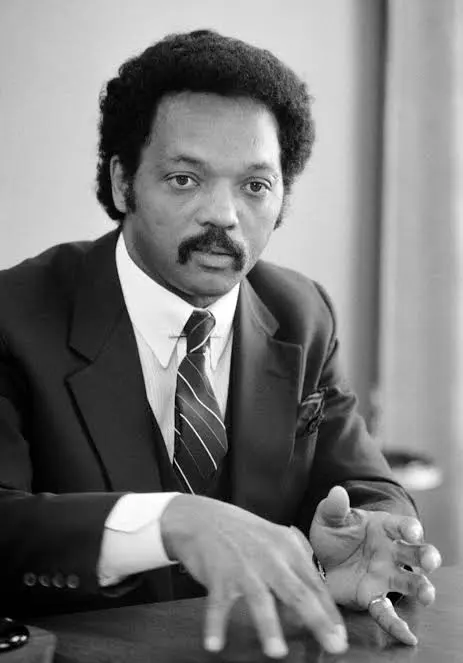
Courtesy Library of Congress (LC-DIG-ppmsc-01277)
Long before he became a minister, head of the Southern Christian Leadership Conference’s Operation Breadbasket, Operation PUSH (People United to Save Humanity), and founder of the Rainbow Coalition, Jesse Louis Jackson impressed his family and close friends as a person destined for greatness. Born Jesse Burns in Greenville, South Carolina, on October 8, 1941, to Helen Burns, a 17-year-old unwed high school student, and Noah Robinson, her older married neighbor, young Jesse took the surname Jackson from his adopted father, Charles Jackson, who later married Burns. Insecure because of the circumstances of his birth, Jackson decided to become a father figure and a leader of his people.
Tall and imposing at 6’4”, Jackson became a star high school quarterback and earned a football scholarship at the University of Illinois in 1959. After one year at Illinois, he transferred to North Carolina Agricultural and Technical (A&T) University in Greensboro, North Carolina, partly because he was not allowed to play quarterback. At A&T, Jackson used his oratorical skills and charismatic personality to become the student body president. Encouraged to test his leadership skills, Jackson led his first march to downtown Greensboro in 1962. Jackson pledged Omega Psi Phi Fraternity while at A&T. Under the guidance of A&T President, Dr. Samuel Proctor, Jackson enrolled at the Chicago Theological Seminary to train for the ministry. Jackson was ordained a Baptist minister in 1968, although he left the Seminary two years earlier to work full-time in the civil rights movement.
Jackson’s introduction to the Movement came in 1965 when he traveled to Selma, Alabama, to join in the campaign for voting rights. While there, Jackson met Dr. Martin Luther King, Jr., the man who would launch his career as a national civil rights leader. Through King’s influence, Jackson quickly established himself prominently within King’s organization, the Southern Christian Leadership Conference. When SCLC launched its first northern campaign in Chicago in 1966, Jackson was put in charge of its Operation Breadbasket, which used boycotts and selective buying campaigns to win contracts for Black businesses and jobs for Black workers. During the years Jackson headed Operation Breadbasket (1966 to 1971), the campaign generated over three thousand jobs for Southside Chicago residents and increased the area’s income by $22 million. Despite its success, Jackson and Rev. Ralph Abernathy, Dr. Martin Luther King’s successor at SCLC, clashed. In 1971, Jackson left the organization and founded Operation PUSH, where he continued his campaign of economic empowerment.
By the early 1980s, Jackson had acquired a national reputation as a racial justice activist. That reputation was enhanced when, in 1983, he traveled to Syria and made a dramatic personal appeal to Syrian President Hafez al-Assad to secure the release of a captured American pilot, Navy Lt. Robert Goodman, who had been shot down over Lebanon. In June 1984, Jackson traveled to Havana to meet with Cuban President Fidel Castro to negotiate the release of 22 Americans being held by Castro’s government.
In 1984, following the success of his Syrian mission, Jesse Jackson mounted the second major effort by an African American (after Shirley Chisholm in 1972) to seek the Democratic nomination for President of the United States. He and his followers adopted the term “Rainbow Coalition” to describe the broad coalition of groups of color, working poor, gays and lesbians, and white progressives that Jackson hoped would propel him to the nomination and eventually the White House. Despite controversial anti-Semitic remarks made during the campaign, Jackson ran a surprisingly strong race, winning primaries in five states, including Michigan. Jackson garnered 21% of the primary vote but gained only 8% of the delegates and ultimately lost the nomination to former Vice President Walter Mondale.
Jackson mounted a second effort in 1988, this time winning more than seven million primary votes across the nation in another failed attempt to win the nomination. After winning the South Carolina primary, finishing second in the Illinois primary, and winning the Democratic caucus in Michigan, Jackson briefly emerged as a leading contender. Massachusetts Governor Michael Dukakis recaptured the lead with wins in the Colorado and Wisconsin primaries, forcing Jackson to drop out of the race.
Jesse Jackson did not make another bid for the presidential nomination and, since 1992, has functioned as a power broker within the Democratic Party. In 1990, he won the largely ceremonial position of District of Columbia’s statehood senator, a platform from which he argued for statehood for the nation’s capital. In 1997, Jackson launched the Wall Street Project, which encouraged African Americans to become stockholders to use their leverage to force changes in corporate culture and behavior. Two years later, Jackson engaged in personal diplomacy once again when, during the Kosovo War, he traveled to Belgrade to meet with Yugoslav (now Serbian) president Slobodan Milosevic, where he secured the release of three U.S. prisoners of war. In 1999, he brokered a cease-fire in war-ravaged Sierra Leone.
Both his supporters and critics described Jackson as bold, defiant, and controversial. He has received praise for inspiring the poor with speeches punctuated by catchphrases such as “I am somebody” and “keep hope alive.” Critics, however, blamed Jackson for mounting blatantly self-promoting campaigns that exploited racial grievances and inflamed racial outrage. The revelation that Jackson, married since 1962, fathered a child in 2001 with Rainbow Coalition staffer Karin Stanford, sullied his well-crafted public image as a moral leader. Nevertheless, Jesse Jackson remained enormously popular both in the United States and abroad. Rev. Jesse Jackson died on February 17, 2026, at the age of 84, closing a career that reshaped modern civil rights activism and Black political life.