

The Streisand Effect: Why Hiding Information Backfires
Streisand effect, phenomenon in which an attempt to censor, hide, or otherwise draw attention away from something only serves to attract more attention to it. The name derives from American singer and actress Barbra Streisand’s lawsuit against a photographer in 2003, which drew attention to the photo she was suing to have taken off the Internet.
Key Takeaways
- The Streisand Effect happens when trying to hide information makes it more popular instead.
- When people try to hide something, it often attracts more attention and curiosity.
- To avoid the Streisand Effect, be open and honest if there’s a problem.
The Streisand Effect describes a situation in which a person or organization’s attempts to suppress information leads to greater attention to the information than it would have received otherwise. Not surprisingly, the term was named after singer Barbra Streisand. Before it was known as the “Streisand Effect,” however, there was a long and fascinating history of failed cover-ups that provide an interesting glimpse into the human psyche and our need to get to the bottom of things.
Origins of the Streisand Effect
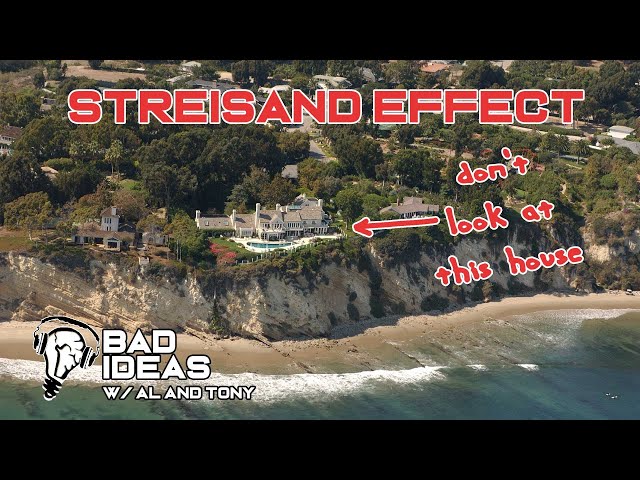
Mike Masnick, founder of the website Techdirt, coined the term “Streisand Effect” in 2005, after the singer and actress sued the photographer Kenneth Adelman in 2003 for $50 million. Adelman had taken thousands of photos for his online database for the California Coastal Records Project, a resource that provided pictures of California’s coastal erosion to scientists and researchers, and one of these photos happened to show her mansion in Malibu.
Before Streisand sued, the image in question had been downloaded only six times; afterward, it received over a million views and was reprinted countless times. Streisand ultimately lost the lawsuit and had to pay Adelman’s legal fees.2 Streisand’s concern for her privacy was not unreasonable—she had been stalked before. But in this case, she would have been better off just leaving things alone. So, what causes this effect to play out as it does? We’ll explore the causes, provide some real-life examples, and even provide some guidance on how to avoid it in your own life.
Streisand’s lawsuit was filed against photographer Kenneth Adelman, the founder of the California Coastal Records Project, for which he photographed the coastline of the state from a helicopter and posted the photos to the Internet. Adelman indicated that the images were free for nonprofit use and had been used by government entities for scientific research. Among more than 12,000 photographs of California’s coast was one photograph in which Streisand’s mansion appeared. Streisand, who had in the past been harassed and stalked by fans, sued for $50 million, claiming that the photo violated her privacy and showed how to access her residence.
At the time the lawsuit was filed, the photograph had been downloaded only six times, including twice by Streisand’s lawyers. The lawsuit was highly publicized, and a flurry of interest and activity followed. In the month after the filing, the photo was viewed more than 400,000 times and reposted on news sites and elsewhere on the Internet. Thus, Streisand’s attempts to have the photo suppressed made it exceptionally more visible than it would otherwise have been. Streisand lost the suit and was ordered to pay Adelman’s legal fees for the case. The photo remains widely published on the Internet.
Understanding the Streisand Effect
With the Streisand Effect, if someone tries to hide, remove, or censor information, it can backfire. In fact, it can have the unintended consequence of drawing more attention to the thing they are trying to suppress.
As Cara R. Stewart, founder and CEO of Altalunas International, says, “It’s a classic example of having a legitimate concern but choosing an ineffective or counterproductive way to address it. Barbra Streisand’s concern about her privacy was understandable… However, the tool she chose to manage this—filing a lawsuit—was not only ineffective but actually worsened the situation.”
Moreover, the effects can be even more insidious. “There is also the risk of the erosion of trust in institutions or authorities responsible for the censorship,” says Carly Dober, psychologist and founder of Enriching Lives Psychology. “When people discover that information is being withheld or manipulated, they may become skeptical of the motives and credibility of the censors. This can foster a culture of distrust and encourage individuals to seek alternative sources of information, which may not always be reliable or accurate.”
Factors Contributing to the Streisand Effect
There are several factors that contribute to the Streisand Effect. First, psychologically, when people discover that someone—especially someone famous or well-known—is trying to hide or censor information, people become curious and rebellious. “This is driven by a fundamental human instinct to seek out forbidden or restricted knowledge, amplifying interest and dissemination,” explains Dober. Second, people are also motivated by psychological reactance, where one asserts their autonomy over the suppression of information by seeking out the restricted information.
“When people perceive that they are being denied access to information, their desire to obtain that information intensifies,” says Dober, “driven by a sense of defiance and a need to restore their freedom of choice.”
While the Streisand Effect existed prior to Barbra Streisand’s lawsuit in 2003, the internet, and more specifically, social media, has exacerbated the effect even more. Online communities and social media platforms encourage the rapid spread of content and enable information to go viral.
“When users encounter attempts to suppress information, they are likely to share it widely as an act of resistance, bolstered by a collective sense of injustice,” says Dober. “The social validation and reinforcement from peers further encourage individuals to participate in spreading the censored content. Additionally, the internet culture of digital activism fosters an environment where combating censorship is seen as a moral or ethical duty.”
This all combines to create a powerful set of factors that contribute to people’s responses, and makes the Streisand Effect a reality.
Real-Life Examples of the Streisand Effect
While the Streisand Effect existed before it was named, it has become increasingly likely to happen as more and more people have taken to social media. Here are some examples:
- Examples:
- Scientology: Attempts to take down a video of Tom Cruise led to it being reposted and viewed millions of times.
- Beyoncé: A request to remove “unflattering” photos from BuzzFeed in 2013 led to the images being shared more widely. In 2013, per Stewart and Dober, after Beyoncé performed at the halftime show at the Super Bowl, Buzzfeed posted some images of her from the middle of her routine. Shortly afterward, Beyoncé’s publicist reached out to Buzzfeed to ask that they take down some of the “unflattering photos.” Buzzfeed wrote a second article, “The Unflattering Photos Beyoncé’s Publicist Doesn’t Want You To See,” and the images, including some memes, were all over social media for months.
- In 2012, The Pirate Bay, a site for pirated movies, TV shows, music, and games, was ordered by the UK High Court to be taken down by five internet service providers. The media attention had the opposite effect, though, with the website getting over 12 million new visitors.
- In 2009, per Dober, the oil company Trafigura prevented The Guardian from reporting on the contents of a report about the dumping of toxic waste along the Ivory Coast. After The Guardian reported it couldn’t respond to a parliamentary question about the waste dump, people on Twitter started uncovering the case themselves and publicizing what they found. Trafigura was then ordered to pay residents of the Ivory Coast who had gotten sick from the dump.
- In 2024, the Los Angeles Police Department Foundation attempted to claim copyright of the letters LAPD after the Cola Corporation’s shirt—which said “F*** the LAPD” — went on sale. The claim was not successful and the shirts benefited from the publicity, selling out quickly.
In addition to the above, similar attempts at censorship have been failing long before the existence of social media. Just ask any teenager if they are more interested in a particular band, movie, or TV show that adults claim is inappropriate for them.
Impact and Implications of the Streisand Effect
The Streisand Effect can have long-lasting consequences for individuals and organizations that attempt to suppress information. For individuals, the attention can lead to increased scrutiny.
“This phenomenon can significantly damage reputations meticulously built over the years,” observes Stewart. Dober concurs, adding, “This damage is not easily undone, as the initial act of suppression can create a lasting impression of dishonesty or untrustworthiness. For individuals, this can affect personal and professional relationships, career prospects, and public perception.”
For organizations, the losses can be great as well. “The Streisand Effect can severely damage brand reputation and erode trust with consumers and stakeholders,” says Dober. “This can lead to a loss of customer loyalty, decreased sales, and a tarnished public image. Additionally, efforts to suppress information can result in increased media scrutiny and regulatory attention.” Dober adds that it can take a long time to recover one’s reputation from this sort of error.
For society as a whole, the Streisand Effect has implications for free speech. Because attempts at censorship often fail, it shows the enduring resilience of freedom of speech in the digital age. “This phenomenon can also lead to greater public awareness and dialogue about important issues, promoting accountability and democratic values,” Dober observes.
“However, the widespread sharing of censored information can also lead to the dissemination of misinformation if [the censored information is] not properly contextualized,” she says.
Strategies to Mitigate the Streisand Effect
There are many strategies to mitigate or avoid the Streisand Effect. These include:
- Respond quickly: As Stewart says, “A rapid response can prevent the issue from escalating, but it’s equally important to ensure your reactions are thoughtful and well-considered.”
- Practice transparency: Stewart explains that you should be transparent about acknowledging the problem and the steps you will take to address it. “This approach shows that you are not only aware of the issue,” says Stewart, “but are also actively working towards a solution…. This approach doesn’t just mitigate damage; it can enhance a reputation, demonstrating a commitment to ethical practices and responsiveness….”
- Be polite and professional: “It’s easy to become defensive when under fire,” claims Stewart, “but the goal is to acknowledge concerns and focus on resolving the issue constructively.”
- Refrain from litigiousness: Suppressing information via a lawsuit can attract media attention, and by extension, curiosity from the public. “Instead of resorting to lawsuits,” Dober says, “individuals should consider alternative dispute resolution methods, such as mediation or negotiation, to resolve issues privately. By avoiding high-profile legal battles, individuals can prevent drawing additional attention to the information they wish to remain private.”
- Practice emotional regulation: Developing coping mechanisms, like emotional regulation, can prevent people from reacting impulsively when information they’d like suppressed comes out. “Therapy can help individuals develop coping mechanisms for dealing with stress and anxiety related to potential public exposure,” says Dober.
- Develop a strong support network: Your support network should include friends, family, and even professional advisors who can offer emotional support, advice, and practical assistance if a crisis strikes. “This network can help individuals navigate complex situations without resorting to actions that might trigger the Streisand Effect,” Dober observes.
Emotional regulation techniques, such as mindfulness and stress management, can provide a clearer perspective on how to handle sensitive information and public scrutiny more effectively.
International Journal of Communication 9(2015), 656–671 The Streisand Effect and Censorship Backfire